Showing posts with label Ignatius. Show all posts

Saturday, November 16, 2013

I Love Teaching Intro to Religion!

I am procrastinating grading so . . .
 
From some college student reflections:
 
"At first I was not happy about the requirement to go to outside events, but now that I have been to a lecture and a mass, I feel that I have gone outside my little bubble and witnessed others' beliefs and thoughts."
 
"Learning about the history of the Bible is surprisingly interesting."
 
"Religion has not been a huge factor in my life in the past several years, but now I think I might go back to temple."
 
"I had never really thought about the possibility of multiple interpretations of a Biblical text."
 
"To be honest, I was not looking forward to this course at all . . . but now I am excited to take my next course next semester."
 
 
Yes . . . there was at least one very unhappy student ~ I'm afraid I was a bit sarcastic one day and my meaning got lost, but I was very glad that she raised her concerns so that I could address them.  (At least I hope I did.)
 
I have been a bit preoccupied with my old church-new church stuff this term, and sometimes I feel more behind and confused than my students do.  We cover way too much in this survey course -- from Ignatian spirituality to Tillich to Freud to Frankl to Biblical criticism and exegesis to interfaith dialogue to Islam to justice.    The instructors have a lot of leeway, as long as we cover some basic ideas foundational to discussing religion, address the Bible and interfaith dialogue, and deal with a religion assigned by the department -- that's where Islam came in this semester. 
 
I started with Ignatian spirituality -- something almost no other instructors do, but hey: we're in a Jesuit university and I think it's always a good idea to understand your heritage.  Whether they are Jewish or Christian (no Muslim students this term), Ignatius has become a part of their heritage by virtue of their presence at the school.  And I'm ending with a discussion of justice across traditions because soon it will be cold and dark and stressful all the time, and I think that's something they can sink their teeth into even when they've about reached the end of the semester.
 
The most fun?  Reading their reflections on their "outside experiences" ~ a Catholic-atheist debate, an apparently dynamite lecture on the theology of sports (I have a number of athletes in class), Jewish and Methodist students at mass, a Catholic student at my home Presby church, a martial arts class, an Otis Moss, Jr. sermon ~ I think they're having a good semester.
 

Wednesday, January 16, 2013

Just for Fun


I am inundated by church bureaucracy and by too much in general.  A lot of it Very Serious Stuff.  And I want to get back to my posts on the church. 
But: No time.
 
So for now, a New Year's present that arrived a couple of days ago
from a friend!

Monday, September 17, 2012

Ignatius and Religious Experience


Here is my big personal take-away, something that has never occurred to me before, from the Friday evening portion of the week-end's program on Ignatius and his incarnational theology:

Ignatius was able to discover what he did about religious experience precisely because he had an inadequate education.

Irony of ironies.  Especially if you know about or have any connection with the Society of Jesus, which runs schools and universities all over the world, and which requires a formal education of its members that is the envy of anyone who wishes she had been directed into three years of philosophy studies before she touched theology.

Let's step back a bit.  Ignatius was a minor 16th century Spanish nobleman, a youngest child, and was therefore provided with only the rudimentary education needed to sustain a military career.  He was a soldier who drank and caroused (career choices which instill great affection for him in college students, when they discover through his biography that lifelong perfection is not a prerequisite for idealistic service to God), and then through an arrogant misjudgment in battle encountered a cannonball that altered the course of his life.  

It was while he lay in bed recovering from his injuries and in the months of pilgrimage following that he had the experiences in prayer and began to develop the practices that became the Spiritual Exercises

Our presenter pointed out that it is through higher education that we are given the framework that enables us to analyze and understand and discuss the world ~ but Ignatius did not have that particular advantage.  And so he fell back on his own experience of God.  

That experience created some bewildering difficulties for him, and he did eventually pursue the course of education that made it possible for him to be ordained a priest and, eventually, to become one of the most gifted of organizational administrators.

But his experience also enabled him first to encounter God deeply and affectively, with his feelings more than with his mind, and to pass on to succeeding generations his confidence in our capacity to meet God in our experiences, and to learn to evaluate them, and to proceed accordingly.

I was struck for a number of reasons by the assertion that it was his lack of education that enabled him to develop an experiential approach that can so profoundly change lives.

For one, I have been the beneficiary of excellent formal education in many guises, but it was the experience of the Exercises that changed my life.

For another, my seminary education was extremely lopsided, with a heavy bent toward the academic, and I will be forever grateful that it was balanced by my simultaneous immersion in Ignatian spirituality.  Many of my classmates found their own balance in other ways, especially through travel and mission, or through worship and service in congregations focused on experimentation, but for me, it was Ignatius who opened other doors.

And for a third, while I have an intense bent toward the intellectual and academic myself, and made good use of that approach to contend with Josh's death during my last two years of seminary, when the formal theology all splattered outward, as Aquinas described it, as "so much straw," and God seemed truly and eternally gone, my feelings were both legitimized and challenged through the gifts of Ignatius.

I'm so glad that he wasn't an eldest son destined for university from the outset!


Tuesday, July 31, 2012

Happy Ignatius Day!

Most of this post is from last year:
Today is the feast day of St. Ignatius of Loyola  in the Roman Catholic Church.  And anyone who reads this blog knows that Ignatian spirituality has had a huge impact on me, so it's a pleasure to honor his day, which just happens to come two days after my birthday.

I often wish that we followed a similar practice of celebration in the Protestant Church.  Having attended many Catholic masses in my time, I've heard lots of stories about saints, stories which connect the people of today's church with those of their tradition and history.  

In the Methodist church to which I belonged for a long time, we heard at least a couple of sermons each year about John Wesley.  So I do know about his heart being strangely warmed, and I know a bit about his mother, Susannah Wesley, and his brother Charles Wesley, famous in his own right as a hymn writer. When I went to the boarding school founded by evangelist D.L. Moody, we were all well versed in his life and thought.

But on the whole, we Protestants don't spend a lot of time dwelling upon our forefathers and foremothers in the faith.
In seminary a few years ago, I spent a term doing an independent study on Ignatius of Loyola and John Calvin.  They lived during the same half-century and were even students in Paris at the same time.  When I asked on one of my professors for some assistance in researching Calvin, I mentioned that he seems to have written little about his personal life.  "Of course not!" said professor replied indignantly.  "One who preaches the Word of God should not be focused upon himself!" (What does that say about we who blog, I wonder?)

In reality, Ignatius might have agreed with that professor. I know that Ignatius was reluctant to provide information to the chronicler of his Autobiography ~ but I, for one, am grateful that he was persuaded to do so.  While others have commented upon his apparent stern taskmaster rigidity, I always think of him as an affectionate older brother.  Knowing the story of his life makes his work infinitely more accessible and inspiring in light of the twists and turns of our own.


Today's header comes courtesy of Fran of There Will Be Bread.

Friday, July 20, 2012

Just Call Me Lopez ~ Book Giveaway!

How is it that we discover and pursue an experience that transforms our lives?  For most of us, an introduction is made by someone we respect or admire, someone who transmits to us a deep passion for something of significance in their own lives.  Certainly in the context of faith, it is often a beloved teacher or pastor or writer who conveys to us a depth of commitment that inspires in us a deep longing for a similar engagement ~ be it with Scripture, or liturgy, or theology, or a form of spirituality.  Ignatian spirituality, for instance.

Perhaps Margaret Silf is about to become such a person for you. In her new book, Just Call Me Lopez, this well-known expert on Ignatian spirituality offers an easily accessible introduction to the 16th-century life of Catholic saint Ignatius of Loyola and to the major themes that dominate his work.  The book is a combination of time-travel fiction and introduction to Ignatian principles.  Ignatius himself, dressed in garb reflective of the various ages and stages of his life, appears sporadically to the narrator, a contemporary woman who, providentially, makes her professional living by helping others narrate and interpret their spiritual stories. Her experience enables her to help Ignatius articulate his.  She is at the same time personally contending with real life dilemmas familiar to many of us, so that she in turn gives Ignatius the opportunity to suggest ways in which she might address her own challenges.

When Ignatius drops in to visit, their conversations range across the many adventures, false starts, and challenges that formed one of the great spiritual masters of Christian history. At the same time, they delve into the multitude of insights which we now think of as distinctly Ignatian.  Imaginative prayer?  We learned it from Ignatius.  Principles of discernment?  Almost everything addressing the topic of discernment today has an Ignatian origin, whether recognized or not.  An understanding of spiritual consolation and desolation?  Ignatius is the man.

For the past several days, Margaret Silf and Paul Campbell, S.J. have been engaged in a blogalogue conversation over at People for Others.  On Friday, Paul asked Margaret, "If you had to identify one crucial insight of Ignatian spirituality, what would it be?"  Margaret suggests a number of possibilities; allow me to share one of my favorites:

I was introduced to Ignatius by someone who conveys the Ignatian narrative and spirituality with deep reverence and great good humor, and I began to make the Spiritual Exercises with that then-professor of mine while I was also taking a graduate course from him on Ignatian spirituality.  

What blew me away, lured me in, and completely altered my direction in life was the discovery that my own life experience was of value, that it was ~ and is ~ the raw material with which God works, and that it is the venue through which Jesus reaches out to me.  

I chuckled when we began to read Ignatius' autobiography in class, observing his many mishaps and missteps, and then, thanks to the care of a spiritual director who listened to mine as though they were of some import, began to understand what Ignatius was saying: experience matters.  We can learn to interpret and understand our experience and our feelings about it as among the ways in which God speaks to us.  We can learn to understand how our desires reflect God's desires for us.  "What do you want?" asks Jesus.  "Important question!" insists Ignatius.

There's a lovely passage fairly early in Just Call Me Lopez in which the narrator reflects upon the bond that she has discovered with Ignatius:

"Its strength and invincibility came from the Spirit of God flowing through it.  Its fragility and its tenderness came from our own humanity.  Together, these can draw the human spirit back from the brink of destruction to the threshold of new understanding" (79).  Indeed: the value of the human experience of friendship in the Lord when understood in light of the activity of the Holy Spirit.

*****

If you'd like to read more about the book, it's being celebrated on various Loyola Press blogs this coming week.  If you'd like to read a personal reflection by another reader, you'll find it at Quantum Theology.  If you'd like to purchase the book, Loyola Press is offering a 30% discount through August 31; use code word LOPEZ.  

And if you'd like a free copy, I've got one to give away!  (Actually, Loyola Press will send it to you, which means that you're a good deal more likely to receive it than you might if you had to depend upon me.) Just leave a comment and, while you're at it, tell us what you like or what makes you curious about Ignatian spirituality. I'll pull a name out of a magic hat on Sunday.  And there's a giveaway at Quantum Theology as well.

*****

Full disclosure: I received a copy of the book and an invitation to give another one away from Loyola Press, with no further obligation on my part.  I also gained an enjoyable read and the re-activiation of some wonderful memories.  The second image above is a photograph (July 2006) of the restored Church of St. Denis in Monmartre (Paris), where Ignatius and his first companions made their first vows to God and to one another, thus initiating the formation of the Society of Jesus.  You can read about it on page 170 of Just Call Me Lopez.


Saturday, February 18, 2012

The Daily Examen (Book Reviews)


Since the Ignatian Prayer Adventure for Lent (see previous post) begins tomorrow, this is an appropriate time to mention a couple of books that do a wonderful job of presenting a crucial spiritual practice that many people refer to, as the first title indicates, as life-changing: the examination of consciousness.  

I have to admit to being lax and erratic in this prayer practice myself, which is why I was grateful when my friend Wayne brought the Jim Manney book back to my attention a few weeks ago.  It's on my Kindle, I'd already read it . . . but for some reason the timing for renewal was just right.  And now Law and Gospel has returned from retreat with a review of the second book.  So, OK: you have my attention.

Most often referred to in the past as the examen of conscience, implying that at its heart is a look at matters of conscience, i.e., sin,  the examen has been re-thought and re-imagined in the past several years as the examen of consciousness, meaning:  It's a way by which we become conscious of how God has been present in our days, of when and where we have been close to God, been moving toward God, been aware of God, and when and where not.  In Ignatian terms, it's a way of becoming aware of God in all things.

The practice itself is simple, although different folks tend to emphasize different aspects.  Essentially, it incorporates a prayer to move into God's light, an expression of gratitude, a look at the events of the day, and a plea for help with what's coming tomorrow.  There is good reason to do it at the end of the day, but any time that works will do.  And while the formal examen itself might take no more than ten minutes, a daily practice is likely to result in a growth in examen-type awareness throughout the day.

Jim Manney's book has more of an instructional bent; the Linn book is more experiential and anecdotal.  They compliment one another well, and both are short, meaning that they are quick reads and easy to refer back to.

The Linns point out that "the criteria for hearing the voice of God, as Ignatius did, is not holiness, but rather the willingness to become aware."  If you've wondered about a more contemplative approach to prayer, about how to pray in a way that involves more in the way of looking and listening than speaking and imploring, the examen is a good place to start.

(And if you'd prefer an article over a book as a starting point, "Rummaging Backward Through Your Day" is another excellent introduction to this little but powerful practice.)

Monday, February 13, 2012

Calvin and Ignatius: The Lighter Side

I've long been intrigued by the simultaneous presence of John Calvin and Ignatius of Loyola in Paris during their student years.  Supposedly their portraits hang next to each other in what is now a government building.  We never managed to see them when we were there a few years go, but a friend and professor of mine attempted to do so last month.  It seems that the paintings have been moved and, according to her FB post, the response of a librarian to her request for information about their location side-by-side was as follows:

"Jamais, jamais ~ cote a cote dans l'eglise catholique ~ jamais!!" ~  with hands demonstrating an emphatic "Impossible!"


Saturday, November 26, 2011

There once was a man . . . (Ignatius)

There once was a man named Inigo.  A poorly-educated youngest of many children who turned to a military career as a likely source of fortune and fame.  A man inclined to the pursuit of women and wine.  A headstrong and impulsive leader who was badly injured after a most unfortunate decision to charge forward where retreat would have been warranted.

And THIS is one of my heroes in faith?  A failed Basque soldier of the early 16th century?

Why not Martin Luther, ardently nailing his 95 Theses to the door?  I do, after all, believe in the possibility and hope of always reforming and always being reformed. Why not John Calvin, with lawyerly and scholarly precision writing and re-writing his Institues? I am a lawyer, and a little bit of a scholar, with two advanced degrees in hand.  Why a man at all, for that matter?  Why not St. Brigid, or Julian of Norwich, both of whom brought healing and learning to others in difficult times?

Oh, each one of them has his or her place.  But Ignatius, as he came to call himself . . .

Ignatius spent those long months of bedridden recovery learning to pray.  He learned to meld two stories, that of the Biblical narrative and that of each individual's, into a form of prayer that emphasizes human experience and emotion, that recognizes God laboring in all things that we encounter, that seeks the companionship of Jesus Christ, and that embraces the Spirit's activity in all that we do, and say, and ponder, and hope.

It's not surprising, I think, that as I recover from this wretched surgery and anticipate months more of treatment, I would re-connect with Ignatius.

After he got out of bed, Ignatius had some rather dramatic experiences and did a few weird things.  He made some mistakes, and he returned to school to remedy his academic weaknesses. He formed a small band of followers during his studies in Paris, and the Jesuit order was born.  He transferred his own passion and desire for mission and travel to his men, sending them around the world (and yes, we studied Jesuit missions extensively in my Presbyterian  seminary!) while accepting that his own role called for him to remain in Rome, drafting documents, organizing Jesuit activities, and writing ~ more letters than anyone else in the 16th century.

And how did Ignatius become a hero of mine?  Because one person ~ one elderly, wise, and wickedly funny Jesuit ~ took the time to share his deep love of his spirituality with me.  The Spiritual Exercises of St. Ignatius are, at their very best, a matter of oral tradition, handed from one person to another.  I am often awed by the fact that they made their way from Ignatius to his first followers, to others across the oceans and down the centuries, to a Jesuit who became a key figure in their renewal in recent decades and who gave them to me, and now are passed from me to others.

One-on-one.  There are other Jesuit companions in my life now, and in them I have seen the same generosity, the same intense desire and commitment to share in the prayer and lives of others.  The same willingness to recognize the presence of Jesus in the lives of others.  The same gift of the spirituality of contemplation in action that made it possible for me to move forward, with much help, after the death of my son.

And so, as I emerge from the haze in which I've spent the past week, that's who and what I'm thinking about.  I'm disappointed that I won't be spending the first Sunday of Advent with my congregation,  but perhaps this little respite is exactly what is called for, a transition from the self-absorption of illness back to openness to others.

I would rather be spending my retreat time in a state of good health at Wernersville than in recovery in on the recliner in the living room ~ but then, Ignatius would have preferred India to Rome.

Image: Ignatius the Pilgrim at Guelph (ONT) Retreat Center

Thursday, November 3, 2011

Paris, Ignatius, Calvin, and Me

It's been a little more than five years since I wandered the streets of Paris, thinking about Ignatius of Loyola and John Calvin, who had both studied in the same neighborhood in which we were staying ~ wondering whether they ever met, and musing about the diverging paths the Catholic and Protestant churches were taking during those early years of the 16th century ~ paths that would converge in my own rather eclectic spiritual life. (All of those questions eventually led to an independent study in seminary!)

One afternoon that week, I sat in the Chapel of the Martyrs in Montmartre, imagining Ignatius and the first Jesuits there 450 years earlier, committing themselves to God and to one another.  I prayed the final prayers of the Ignatian Spiritual Exercises, and made my own commitment to following the path toward ordained ministry, if that were really what God had in mind.  A big IF, I might add.   I laughed and I shed a few tears, and I guessed that not too many paths toward ministry in the Presbyterian Church have begun in that particular setting.

I have most assuredly had many opportunities to wonder whether I had taken off down a road completely of my own making, one that perhaps had very little to do with God.   At the time, during those days of discernment five years ago,  it seemed that three years of seminary, requiring me to live in two cities, would be something of a challenge.  That it might be difficult to pursue both a certificate in spiritual direction and an M.Div., at the same time.  That I might be a little too old.

Those concerns seem so trivial now, in light of the death of my son and the new challenge of breast cancer ~ matters which have caused me to question everything I have ever done and to ponder whether I should simply pull the front door of my house closed and never venture out again.

But ~ here I am.  I have consecrated and served bread and drink.  I preach every Sunday now.  Yesterday I spent the waning hours of the afternoon riding in a tractor and then a truck as one of my parishoners gave me the grand tour of his farm.  In two more weeks I will have major surgery.  I am a minister of word and sacrament, and one of the many times and places in which that astonishing reality began to take shape was in the small chapel about which I at that time wrote the following:

While I had initially planned a trip to Paris in large part for the purpose of getting to Chartres, the Jesuits found their way into my objectives, too.

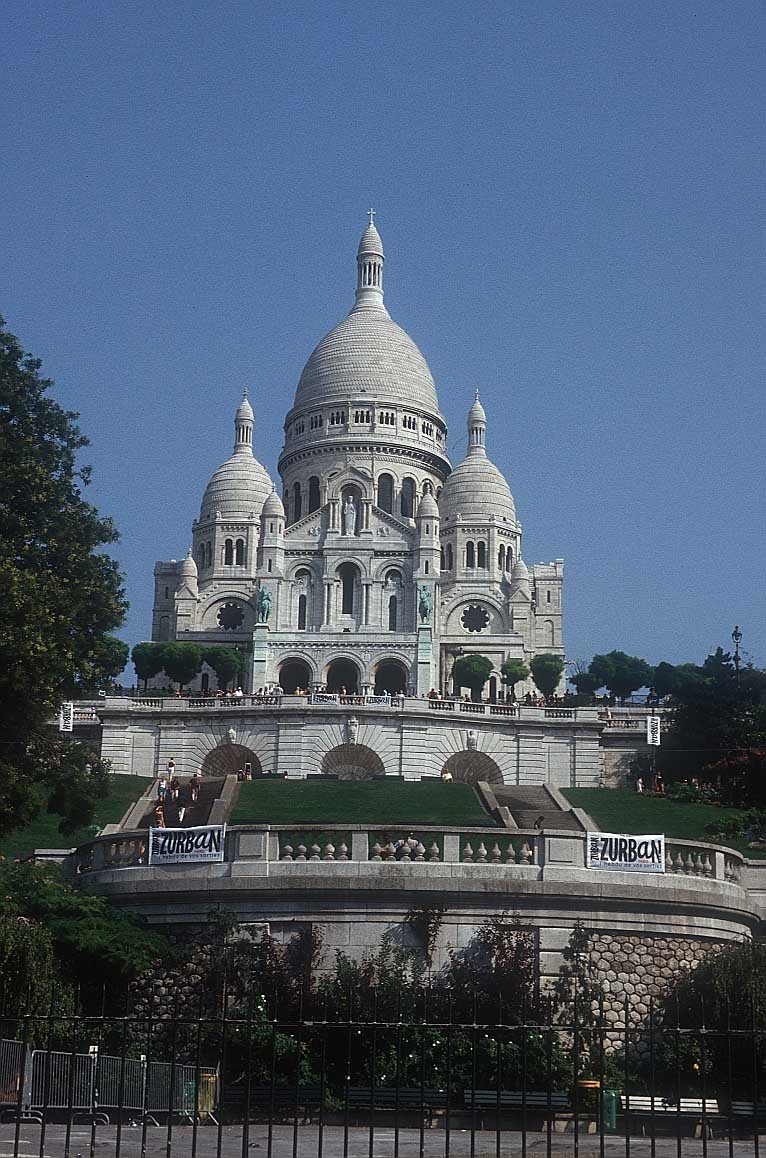
My quest eventually focused in on Montmartre and on the tiny church at the foot of the Basilica of Sacre'-Coeur known as the Chapel of the Martyrs. Sacre'-Coeur is a famous landmark in Paris if for no reason other than its singular appearance on a hillside to the north of the city.

Almost no one has heard of the Chapel of the Martyrs, and probably very few people stumble across it, located as it is on a side street slightly out of the way of the usual Montmartre walking routes. I was at something of a loss myself, until at the very last minute I stumbled across an article giving the address and indicating that it might be open on Friday afternoons.

"Okay," I announced, our first full day in Paris being also our only Friday there, "we are off on a quest for the first Jesuits," seven men who met in the Chapel of the Martyrs and made their first vows among themselves on August 15, 1534. The chapel itself was, like many of the sacred buildings in France, destroyed during the French Revolution and rebuilt during the next century.We found it nestled on a busy side street, almost hidden behind scaffolding, but with a sign indicating that it would open at 3:00.
 

The chapel itself is nestled partway underground and maintained with the simplest of decors -- whitewashed walls, clear windows, a plain altar, and a large oil painting on the wall of the Jesuits making their vows at that spot. I won't try to convey what it meant to me to sit there quietly for an hour, to pray and absorb the powerful event that had taken place there but, after nearly a year in the company of Ignatius, it was one of the most moving experiences of my life.

I guess it took.

Saturday, July 30, 2011

Happy St. Ignatius Day!


Tomorrow is the feast day of St. Ignatius of Loyola  in the Roman Catholic Church.

I often wish that we followed a similar practice of celebration in the Protestant Church.  Having attended many Catholic masses in my time, I've heard lots of stories about saints, stories which connect the people of today's church with those of their tradition and history.  

In the Methodist church to which I belonged for a long time, we heard at least a couple of sermons each year about John Wesley.  So I do know about his heart being strangely warmed, and I know a bit about his mother, Susannah Wesley, and his brother Charles Wesley, famous in his own right as a hymn writer. When I went to the boarding school founded by evangelist D.L. Moody, we were all well versed in his life and thought.

But on the whole, we Protestants don't spend a lot of time dwelling upon our forefathers and foremothers in the faith.

Anyone who reads this blog knows that Ignatian spirituality has had a huge impact on me, and so it's a pleasure to honor his day, which just happens to come two days after my birthday!

I have another photo to post in a couple of days, but it's a surprise for someone elsewhere, so we'll have to wait.  The one above is of the statue of Ignatius the Pilgrim at the Jesuit Center in Guelph, Ontario.