Showing posts with label Art. Show all posts

Saturday, June 15, 2013

Be The Change - Part II


"All you have to do to effect change is get 535 people to do the same thing at the same time."

So said the lobbying expert who offered us tips and inspiration for speaking to our congresspeople.  We would be on the Hill the next day to get 535 legislators to do the same thing: to listen and read our stories and to support the many legislative proposals now before or en route to Congress which affect mental health.

On Wednesday afternoon we gathered to introduce ourselves (quickly), learn about lobbying, and learn about legislation.

Ourselves: The most recent loss was three months ago.  The most distant: Over twenty years.  Lost to suicide: sons, daughters, mothers, fathers, brothers, sisters, husbands, wives, uncles, aunts.  All kinds of people there, all kinds of ages and occupations and sorrows and hopes.  (One other pastor, an Episcopalian priest.)  I was in awe of the mother who lost her son three months ago.  I remember the three months marker, because that was when I went back to seminary.  I remember the fog, the searing pain, and my bewilderment at the utter ludicrousness of what I was trying to do.  I remember my daughter saying, "Mom, you have got to get out of bed."  I remember the couple of friends who became my armor, accompanying me everywhere, trying to make sure that I wouldn't fall down and die.  How did that woman get on a plane and fly to Washington?  How did I get in a car and drive to Pittsburgh?
 
There are a lot of really strong and brave people out there who could have been dining with their families and watching television on Wednesday night, but chose otherwise. Some of them are truly heroic.

The legislation: Full funding for the National Violent Death Reporting System, currently only accessible to 18 states.  The System would further comprehensive and accurate reporting of violent deaths, data essential to research and policy development. 
 
(It was to prove extremely fun the next day to calmly tell a member of the House Appropriations Committee that I wanted him to vote for $25 million dollars for this System.)
 
The Mental Health First Aid Act, which would funnel funds to states for mental health training for first responders.  As was pointed out to us, some decades ago, people thought it would be impossible or difficult to help those suffering from heart attacks -- and now CPR training is common across the country.  Wouldn't it be something if basic mental health first aid was as accessible?
 
And other legislation related to mental health and safety issues for schools, Indian reservations, and young people, and legislation designed to promote the development of medications.
 
After dinner we gathered in our state groups to figure out and practice how we were going to present ourselves and our issues.  We were well prepared and, I gotta tell you, Ohio was the last to leave the conference room!

*****

The quote comes from a Native American artist whose work we were to see at the American Indian Museum on Friday.  It seems appropriate to the entire enterprise in which we were engaged.

Wednesday, March 6, 2013

Women


Two Women Seated ~ Charles Malcolm Campbell
Today's Cleveland Museum of Art Facebook Image
 
Why did this painting strike me so today?
 
I think, as I reflect upon it, of three immediate reasons.
 
Yesterday, another woman made a humorous and yet serious remark ~ we all know what those are ~ about the behavior of women in groups.  A remark which revealed an inner adoption of a disturbing and belittling stereotype.
 
A few days ago, I listened to a sermon in which a young man made a joke ~ received appreciatively by his congregation minus one ~ demeaning to women nurses.  I am sure he would be appalled to hear what he said as I heard it, but there it was.
 
And on the sites I am visiting for Lent, I am a little over-inundated by Father language for God.   OK, more than a little.
 
***
 
I've had a number of reasons over the past few weeks to consider the formative experiences of my life.  And among them, the friendship of women looms as a sunny, serious, and sometimes stormy theme.
 
In my family of origin?  Not so much.  No sisters and mother gone much too soon.
 
In my own family?  Oh, that daughter of mine ~ grown into such a beautiful and wise friend and companion.
 
And in between?  All those years ~ eight! ~ of single-gender schools.  Brilliant and funny and compassionate and effective women in almost every place and situation since.  Today, a group of women who have shared life in our community for 25-plus years, an internet group of friends who have done the same for . . .  how long? I don't know . . . and the bereaved moms who have been my lifeline countless times in the middle of the night.  Plus women here and there who have become great friends in all sorts of ways having to do with writing and birding and photography and ministry and politics and spirituality.
 
***
 
I love this painting.


Saturday, December 22, 2012

Family Pictures (Hebrews and Luke)


We all have lots of family photos, right?  Maybe they’re preserved in albums, or even carefully arranged in scrapbooks, with captions and other memories tucked in next to them.  Or maybe they’re piled up in drawers or boxes.  These days, lots of those precious photos might exist solely in internet form: in emails, on websites, in computer files – never printed out.  But in one form or another, we all save pictures.
Have you ever wondered what Jesus’s family pictures might look like?  Of course, he didn’t have any. He made his first appearance on earth about 1800 years too early for a family photo album.  But, as the writer of the letter to Hebrews reminds us, he was born into a body destined to be offered for us all  -- he was a human being, with a distinctive appearance, just like the rest of us.
And what about the rest of his family?   This week, my question has been: What might Jesus have said about his mother?  And it occurred to me that a child today often looks to photographs in order to learn the stories of his family from the days before he was born.  So what about those family pictures?  What about the pictures, similar to those we might take today, of an expectant mother?
There may not be family photographs, but there are LOTS of pictures, centuries of drawings and paintings and stained glass windows and sculptures, depicting the event we call the Annunciation, the story told in the Gospel of Luke of the appearance of the angel Gabriel to Mary. It’s long been one of the most popular of subjects for painters, and today I’d like to share two of them with you.  Two family pictures.  You have copies of them on the insert in your bulletins.


The older of the two, the one before you in which the angel and Mary are both garbed in pink and Mary wears a blue robe, reminds me of those formal family pictures we all take on special occasions: holidays and weddings and graduations and proms.  Everyone wears his or her best and gathers before the photographer in some sort of arrangement that allows all to be included. Today a new sort of these photos has become popular: we often take them on the beach or in a park, and there are often relaxed poses included among the more formal ones: children leaping, adults in unusual poses, family pets included. An entire bridal party about to fall into a lake, as happened when my niece’s wedding attendants posed themselves on a dock and the dock began to sink. “Wearing our best” may mean that we all wear jeans and matching shirts in shades of blue and white.  But we still put a lot of preparation and time into planning these pictures, which are intended to become family heirlooms.
That’s the kind of painting that Fra Angelico created, sometime between 1430 and 1450.  Fra Angelico – his name means “Angelic Brother” and is how he is known to us today  – was a Dominican monk known as Brother John to his contemporaries.  He painted several versions of the Annunciation, all of them formal and stylized, as was typical of the time.  How might we look at this version as one of the family pictures of Jesus?
 
It represents the scene and the angel and Mary, much as we might traditionally think of them: Formal in their relationship, quiet and modest and submissive in their demeanor.  The effect is similar to that of a formal portrait today: the figures seem to have stepped out of time,  into a moment we want to preserve as unique, as distinct from all other moments.  It’s not particularly realistic – they wear the clothing of the 1400s, and the setting is a European monastery; robes and architecture Fra Angelico and his friends would have known, not those of Bethlehem at the time of Jesus’s birth.  But it does represent a striking, out-of time moment.

Also, the artist includes all kinds of symbols reflecting that moment.  Our similar formal portraits include bridal bouquets, wedding rings, diplomas, caps and gowns, Christmas trees – we use symbols to highlight the importance of the event.  What does Fra Angelico include?  The Face of God the Father carved into the archway.  The light and dove of the Holy Spirit directed toward Mary.  The book on her lap, representative of the Word, the Word Jesus Christ whom she will bear.  And in the background: Adam and Eve being expelled from the Garden by another angel, the archangel Michael.  Another moment in time; the distant event this new movement in time is intended to heal. 

What moment, exactly, is this? This painting depicts a moment toward the end of our Scriptural passage, which tells us that “Mary said, ‘Here am I, the servant of the Lord; let it be with me according to your word.’” It’s that light of the Holy Spirit streaming toward Mary that tells us: She has said “Yes.”  Perhaps she and the angel bow to one another in humble acknowledgment that the pivotal event in history has been launched.  All depended on her: on her openness, on her receptivity, on her “Yes” to God’s movement in her life, on her willingness to fulfill her mission in life by becoming God’s servant.  And she has quietly but powerfully said, “Yes.  Let it be according to the will of God.”

Have you experienced moments like this in your own life?  Moments in which the clarity of God’s call in your own life has been unmistakable?  Experiences of great significance from which all else followed, times at which, had a photographer been present, he would have captured a turning point in your life?  Perhaps a marriage proposal over a candlelit dinner?  Perhaps a church service, or a long walk, during which you came to a decision about your education, or your life’s work?  Maybe an encounter in an office building, when you signed the mortgage papers for a farm, or the document committing yourself to military service?  Do you remember your own sense of openness, of receptivity, of willingness?
Maybe, maybe not.  We’re not always entirely sure, are we?  And the moment of transformation is not always one of such formality.


Our second painting, on the other side of your page, is perhaps a more accurate depiction of how many different emotions Mary might have experienced on that day on which God so dramatically intervened in her life. This painting (which just happens to be one of my most favorite works of art) is a much more recent one, created in 1897 by Henry Ossawa Tanner, an African American whose father was a minister in the African Methodist Episcopal Church. Tanner had traveled in the Holy Land, and his painting reflects the people and places he saw there.  He tried to paint surroundings of the Annunciation much as they might have existed in real time, rather than in a setting of his own time.

What do we see in this painting?  Certainly not the idealized, formal setting of other.  This painting is much more like one of our own snapshots of an unexpected encounter, rather than a formal portrait of an occasion for which we’ve planned. The room is a rough, simple, even disheveled setting.  Mary sits on her rumpled bed, somewhat rumpled herself, with a blanket hanging on the wall – not in a regal gown and robe, and not on a throne covered a ceiling of stars.

I think that the most astonishing feature of this painting is the angel Gabriel, who appears as a a column of light.  It’s one of the reasons I like the painting so very much.  How would an angel appear  to us?  We are used to thinking of wings and white robes because that’s what’s always been presented to us – but isn’t it possible that an angel would shine and shimmer with the light of God?  Isn’t a pillar of light perhaps more likely than someone who looks like we do, except with wings? 

I always think of this as a particularly uncompromising pillar of light: intense, filled with strength, communicating the passion of the possible transformation of all history.  Something that might rub off on you if it were to approach you.  Our hymn this morning says that Gabriel had “eyes of flame.”  What else could possibly be the case, on this day on which heaven met earth, than fire, flame, light?

And now, look at Mary in Tanner’s painting.  It’s difficult to know, looking at her, exactly which moment in the story this painting reflects.  Sometimes what I see in her face is surprise, puzzlement, wonder – what you might expect from a young, a very young, woman in her circumstances. I see that sentence early in the narrative: “[Mary] was much perplexed by his words and pondered what sort of greeting this might be.”    I see her thinking: I am a poor and insignificant girl in a poor and unknown family in a poor and small town.  How is it that an angel appears and addresses as “favored one.”  I would be surprised; wouldn’t you?

Sometimes I see skepticism – a hallmark of young people in their early teens.  Sometimes I see her asking, “How can this be?” Focused on herself for a moment, knowing that, although she is engaged to be married, she remains a virgin, so a pregnancy is an impossibility.  

And at other times, I see in that youthful expression a directness and calm as she looks into the face of her future – a directness and calm that can only reflect a peaceful  acceptance of all that the future would bring.  I see her receiving and accepting, as she will receive and accept the Holy Spirit, the assurance that “nothing is impossible with God.”  I see the confidence and courage in her response: “Here am I, the servant of the Lord.  Let it be with me according to your word.”

I see in this painting the drama of human life entangled with God-life:  The combination of the mystery of the unknown and the concrete reality of daily life.  The blend of bewilderment and acceptance.  The confusing combination of question and answer.  The journey inward – How can this be?  I am not the person for this – and the journey outward – Let it be according to your word.

As we embark upon the journey of these final two days of Advent, our final two days of waiting and preparation, I urge you to ponder these paintings, as Mary pondered these things, in your heart.  Perhaps you prefer a formal family portrait, one in which all appears clear and certain.  Perhaps you’re more drawn to the snapshots, the moments of ambiguity, the ones which reveal more of a story than is apparent at first glance. 

Whichever your preference might be, the questions for you -- the questions at the heart of these paintings -- the questions as Advent, the season of waiting, becomes Christmas, the season of arrival, remain the same: What is God asking of you?  How do you respond to God?  Are you receptive?  Surprised? Skeptical? Hopeful?  Accepting? When the Spirit of God moves in your life, she brings with her the powerful capacity for a quiet Yes.  Have you found that Yes, as you await the birth of the Savior of the World?
 

Friday, October 5, 2012

Art! - Friday Five


Over at RevGals, Pat has posted a great reflection on the importance of art, and concludes with these questions:

1. Do you have a favorite piece of art in your home? Was it made by you or someone you love? Was it a gift or something you decided to purchase?


It would be difficult to choose a favorite, but for today I'll go with the prints we purchased on Bainbridge Island last summer.  The artist is Brett Varney, and the three pieces said Spring, Summer, and Fall to me.  Last winter we finally got rid of our 30-year-old wallpaper with the tiny country print and painted the walls to create a more contemporary backdrop for art and family photos.  These paintings clearly were meant for the space above our fireplace.  (I'm really enjoying this week's flowers, too, so I'm posting two pictures.)

2. What do you think of the the art in your place of worship? Does it enhance the worship experience? Would you add to it, take away from it, or otherwise change it?

One of our congregants and her daughter make absolutely gorgeous dried flower wreaths for the walls and arrangements for the chancel; they represent our rural area and natural setting beautifully.  We are in the process of repairing and cleaning our stained glass windows, so for several weeks one side or the other has been removed, leaving us with clear glass. Although I am a great aficionado of stained glass, I've enjoyed the summer and now autumn light streaming into the sanctuary and  the opportunity to see the space in a different way.  

I would love to see us house some small exhibits of local artists.  One of many possibilities tumbling around in my head.  The Old Stone Church, where I did my seminary internship, has an art gallery in which some fabulous exhibits have found temporary homes.

3. What public art have you loved-- or hated?

I love the light shows on the cathedral and in the city of Chartres during the summer.  Some people hate them, but I think it's a lot of fun to wander the city late at night looking for the scenes lighting up ancient buildings, and, as with our own sanctuary, I enjoy seeing things differently; in the case of Chartres, the stone of the cathedral in color.


4. What piece of art (famous, infamous, personal, or very, very well known masterpiece) speaks to your soul?

This one of Mary Cassatt's: me with any one of my small blonde people, on hundreds of mornings of my life:


5. When is the last time you created something beautiful, just for you?

Just for me?  I'm realizing that it's been a loooong time.   But when I was making a silent retreat summer before last, I destroyed the art room in the process of making a collage based on the Suffering Servant passages.   In terms of skill, we're talking first grade.  But I do love that collage.

Great Friday Five, Pat - thank you!

Thursday, September 20, 2012

More Interior Design

A few days ago, I posted some pictures from my church office, and promised (?) that there would be more.  Herewith, the more:

You can see that it's a small place.  I use it to meet with people ~ it's a cozy place for conversation ~  but when I'm working on something that involves research and writing, I need a lot more room to spread out.  And there's no room for my books books books. I moved one of the curtains because light is essential to my well-being.


When I headed for seminary, some of my friends asked what I'd like for a going-away gift.  (I was coming back in four days!)  I asked for a framed copy of Naomi Shihab Nye's poem, Kindness ("Before you know what kindness is, you must lose things."  Umm-hmm.):


Last fall, I went to a spiritual directors' continuing ed day on art and spiritual direction, and left with one of the presenter's mandalas.  The colors made me think Spring! on a dreary and rainy October afternoon:


And this is one of my favorite ordination gifts, from a reader who prefers to correspond off-blog:


Sorry about the lighting.  The book is called And Grace Will Lead Me Home and it presents a collection of artistic interpretations of the Parable of the Prodigal Son, now housed at Luther Seminary.  It's one of those books which you approach an image or a page or two at a time, and of course it immediately got me to thinking: Should I start a collection of images and three-dimensional artwork focused on the Woman at the Well?  I'm a little afraid that someone might decide to unload a full-sized well on me, or a collection of antique buckets!  And where would those go ?!

Thursday, August 16, 2012

The Battle We Didn't Choose: Breast Cancer Photography Exhibit


Photographer Angelo Merendino chronicled his young wife's breast cancer journey in a series of photographs which are currently on exhibit in a wonderful space, a former church, on the east side of Cleveland.

I first read about this exhibit when controversy erupted some weeks ago about its placement at The Gathering Place, an organization and facility which offers all kinds of education and support for cancer patients and their loved ones.  Many of The Gathering Place's clients and friends protested its showing an exhibit in which the stark realities of day-to-day life with cancer are depicted.  They found it depressing and disheartening to walk into a place of support and hope only to be greeted by these graphic reminders of serious illness and death.  And yes, Jen Merendino did die.

Angelo has written about The Gathering Place's decision to close the exhibit, and several other related articles and posts appear on his Facebook page.  That's not my issue: I have long understood that my desire to know about and to see birth and death up close are not universally appreciated.  Those great transitions of human life have a claim on my curiosity and imagination that is shared by few people, and my wonder at photography and what it conveys seems to be unlimited.  I never found childbirth photos "gross," and I do not find pictures of illness to be depressing or horrifying.

What I saw in this exhibit was the power of love and the strength of human courage. 

And sometimes, the lack of the latter ~ but then, that is part of the human experience as well.  There is a moving series of photographs entitled "Reactions" that should give us all pause.  They were taken in public places, out on the street.  Jen moves through the scenes, a frail and bald woman grasping a walker, while the faces of those she passes are recorded by the camera.  Curiosity, surprise, distaste, rejection.  I remarked to the exhibitor that in not one of those photographs do we see a stranger reacting with a friendly, welcoming face.

In my favorite photo, Jen is seated, I believe in a window, wearing a dress and painting her toenails.  Her hair is gone, her body is thin, and a cane rests nearby.  You cannot miss understanding that this is a woman in great crisis exerting the power of color and beauty over pain and sadness. 

The woman who owns the gallery ~ yes! an artist purchased this abandoned sacred building so that she could house art exhibits ~ and I talked for a long time.  She lost her first husband to suicide several years ago, and so we were able to talk candidly about how losses of such magnitude change who we are and how we respond to life, and to death.   

I have often mentioned my frustration with the remark "I can't imagine" that comes my way so often.  I believe now that in saying those words people are simultaneously expressing sympathy and erecting a wall of protection around themselves.  We all do care for and love each other, but we don't want to imagine, much less know, the day to day trauma of the lives of others. 

For those who are brave enough to learn this particular walk, these images are a treasure.


Tuesday, August 7, 2012

Doors


Some months ago I gave the Pinterest website a try.  My email was subsequently hacked and phished, and I think that the timing was not coincidental.  Sloppy password decisions.  

I shut my Pinterest boards down (and changed all my passwords to everything), but a few weeks ago I wandered back again.  I love my playtime there.  It's utterly relaxing to engage in a purely visual activity, pinning images of things and places and artwork for the sake of pure enjoyment.

I'm sure, enjoyment aside, that there is deep and dark psychology behind the board choices.  Among my most used is one entitled "Doors."  So far it includes ordinary doors, archways, and natural doorway formations.  I suppose that all those doors that are so appealing to me represent something about my ambivalence about moving forward in life, that oh-so-common blend of curiosity and resistance.  I notice that a lot of people have boards focused on doors, windows, archways, and other sorts of means of passage.

Interesting, isn't it?  Pinterest Rorschach images.


Sunday, June 24, 2012

The Spiritual Exercises in Glass: Seattle University

People have engaged in interpretation of The Spiritual Exercises of St. Ignatius for over 450 years. There was a time, not so long ago, when the Exercises remained entirely within the purview of The Society of Jesus, and were presented to Jesuits in formation via a rigid program of daily preached sessions, in which the young men were instructed as to how and what they were to pray and how they were expected to respond.  Meetings with spiritual directors were rare, brief, and often uncomfortable.

I did not know any of this when I asked an older Jesuit to become my spiritual director and guide me through the Exercises.  I did not know that fifty years earlier he had been one of the men in the forefront of a massive re-thinking of the Exercises, of the rediscovery of the individual retreat -- one director, one retreatant, and a series of quiet meetings in which the retreatant does most of the talking, the director, most of the listening, and the Holy Spirit, all of the directing -- and of the opening of the door to the prayer of the Exercises to all sorts of people from all walks of life.  I did not know until much later that what I experienced in my Year of the Exercises would have been entirely off limits to me only a few decades earlier.

The reinterpretation of the Exercises has not been limited to the written page or spoken word, however.  Much of it has emerged in various artistic forms, forms which include the windows of the Chapel of St. Ignatius at Seattle University.

When we stopped by, my initial goal was to view the panels of St. Ignatius's life, painted by Dora Nikolova Bittau.  I have a set of postcards of the panels, given to me some years ago by spiritual director emeritus.  Once I had looked up directions to the university and chapel, I was also curious about the building, which has generated considerable controversy for its architectural style and its openness to interfaith expression.  I also discovered a brief reference to the Steven Holls windows depicting the four-week sequence of the Spiritual Exercises, and thought that I would like to see them as well.

I couldn't even find the windows at first, although they are on the wall to the left as you enter the building.  They didn't look anything at all like what I had expected.  Actually, once I figured out that they were, indeed, the windows, I still had no idea what they were intended to convey.  I stayed there a long time, staring and thinking my way through the four weeks of the Exercises, and finally came up with an interpretation that made sense to me.

As it turns out, the artist's own views differ somewhat from mine ~ but then that's the joy and challenge of art, isn't it?  You put your work out there, and people attach to it what significance they will.  I offer below my understanding of what I saw.  I'm sorry that the images are so poor; it's a difficult setting for photography, and the rain outside did not enhance the lighting.


Week One: Having spent preliminary time in what Ignatius calls the Principle and Foundation, a period of immersion in God's creative love, in Week 1 we pray over sin and sinfulness and their manifestations in our lives and in the world.  The jagged gash down the middle seemed to me to be representative of that week's focus.


Week 2: We encounter Jesus through his birth and life.  I saw the crosses, symbols of Jesus, as moving in and out and among of the circles, as indicative  of life and its many different episodes and encounters.


Week 3: Passion and Crucifixion.  This window is set high in the wall, and the sense it gives is one of everything falling apart and toppling downward.


Week 4: Resurrection.  An opening tomb?  An opening world?  The opening of the lid captivating human history to human sinfulness?  The breaking apart, opening up, and debunking of the old as all things are made new? 

Needless to say, I was entranced.  I'll add some photos of the chapel itself in another post.


Wednesday, December 28, 2011

2011 Highlight: Tiffany Gardens


My friend Wayne posted some images today of mosaics based on Tiffany designs.  At least I think that's what he posted ~ it's a Wordless Wednesday over at his blog.


His post reminded me of some wonderful artwork I never got around to sharing this past year.


When we visited the Biltmore Estate during our summer vacation in western North Carolina, we discovered that the gardens had all been planted to reflect Tiffany designs.

The photos don't do them justice; they were a delight!

(If you enlarge the bottom image, you will see a dragonfly spread across the diamond-shaped garden.)

Thursday, October 27, 2011

Mosaic of Friendship

Kathryn and I have known one another for a long time.  We "met" in an online moms' forum; we've all been talking and sharing our lives online for 15 years.  Kathryn and I have also gotten together several times, most recently just a couple of months ago.

Wayne and I met more recently.  Somehow our mutual Wernersville connection brought us together, along with our interests in birds and stained glass.  I have a couple of lovely Wayne-designed gifts.

Wayne is married to Margaret; she's a mosaic artist.  She and I share the same birthday, but we have yet to meet.  Wayne and Margaret and Kathryn have met, though.

(I should insert here that Margaret and Wayne gave me a beautiful mosaic cross as a seminary graduation gift last year. They don't know this yet, but the photograph will appear eventually: As promised, that cross was the very first thing I hung on the wall of my study in the church I pastor.)

This afternoon, a small package arrived, Kathryn-commissioned and Margaret-created.  The colors, Kathryn wrote, are those of my birthstone and Josh's:

one for Ohio

Thursday, September 22, 2011

Sarah

"You is kind, you is smart, you is important."
~ Abilene to Mae Mobley in The Help

I don't usually go around repeating self-affirmations, but this is what popped into my mind this morning, as I get dressed to go down to the hospital for  . . .  well, the goals are clear but the outcome, not so much.

I know there are lots varying opinions about The Help, but I saw it (twice) as a film about female solidarity.  And I'm feeling plenty of that, and the male kind as well, this morning. 
 
We should really be thinking about Chris today, though.  The fourth anniversary of Sarah's death comes up in a few days, and some of us know what that means this week is like.  I met Chris because an article about Sarah appeared in our local paper a year after she died, which was only a few weeks after Josh's death ~ and we've become good friends.

Sarah was a graduate student in art therapy when she was swept out into the Mediterranean by a rogue wave.  This Saturday I'll put in an appearance at the benefit for her school's scholarship fund named in her honor, and perhaps return home with a Sarah poster for my new study.

Sarah was for sure good, and kind, and important.


Friday, July 22, 2011

Visual Treats on Retreat

The first one: a beautiful design made by Wayne that looks like stained glass on paper, which arrived in the retreat house mail ~ well, I don't know when.  I looked every day, as Wayne had instructed me to do, and then on Sunday night at dinner a Presby pastor on retreat hissed at me, "There's mail for you!" 

I have not succeeded in photographing what I received, and I can't find anything like it on Wayne's sites, so you will have to be satisfied with the knowledge that it is a wonderful thing to receive a gift made by a friend when you are far from home and immersed in silence.

The next two:  My director commented one day that I seemed very much oriented toward the visual, and suggested that I take advantage of the art room and maybe make a collage.  I went down there that night, sure that I wouldn't last more than five minutes due to my painful wasp-swollen arm, but three hours later I had made a complete mess of the place ~ magazine pages all over the room and glue stuck here and there and markers tossed hither and yon ~  and produced a collage in response to the Suffering Servant Songs in Isaiah.  A couple of nights later I made another one as I rummaged back through much of my prayer of the week.  And so ~

The fourth one:  I seem to have purchased card stock in all colors and also glue and extra-thin marking pens, and I seem to have ordered a lot of my Wernersville photos in wallet size.    I have 15-plus  journals in which I've recorded my prayer life in writing  over the past few years, but now I'm thinking art in miniature. Something much more evocative than what I've ever done before.  I don't think my work is going to appear at MOMA or anything, but I do think it might be fun.  And prayerful.

Thank you, Wayne, and Bill SJ!

Saturday, May 7, 2011

Mother's Day Litany


NOTE: THIS LITANY COMES FROM A PEARL DOWN UNDER, LINKED BELOW.  ITS AUTHOR IS THE PERSON YOU NEED TO CONTACT FOR PERMISSION TO USE.  (And I am happy to add here some information found on the blog of one of her commenters:  it's by the Rev. Patty Lawrence, May 2004
posted on her blog ~ a pearl downunder
on Saturday, May 7, 2011)

We remember Sarai who was taunted by others in the household because of her inability to have children. 

All-encompassing God, we pray for those who feel excluded when we emphasize one kind of family as normal.

We remember Esther, who was adopted and raised by her cousin.  

God who embraces us all, we pray for those who cannot be raised by their parents, for a short time or permanently.

We remember the mother of Moses, who placed him into a raft on the river.  

Saving God, we pray for parents who struggle to raise their children in oppressive circumstances.

We remember Hannah, who loved her child so much she handed him over to another to raise.  

Loving God, we pray for parents who have placed their child in another family.

We remember Naomi, who grieved the death of her sons.  

God who grieves with us, we pray for parents who mourn the death of a child.

We remember Ruth, who gave up her family to be family to another.  

Inclusive God, we pray for those who choose to be family to those isolated by culture or language or distance.

We remember Elizabeth, who had a child in old age and we remember Mary, who had a child as a teenager. 

Ageless God, we pray that as a community we accept people of varying life stages and responsibilities and relationships.

We remember Rachel, crying for her children.  

God of justice and hope, we pray for those whose children are killed, and look to a time when children can live safely in their communities.

We remember Lois and Eunice, who taught Timothy faith by example.   

Faithful God, we pray for those who teach us faith by their lives; may we remember that we also teach about you in the way we live.

We remember other people, not named in the Scriptures, like the mother of the prodigal son.  

Companion God, we pray for those who wait for a phone call or a visit,  cut off from family and friends by distance and disagreement.  

Nurturing God, we give thanks for those
who enrich our lives by their presence
who teach us about your abundant love
who encourage us to journey in faith.


Litany from A Pearl Down Under
Scuplture:  Agia Talassini by Oxana Narozniak, here.


Wednesday, April 20, 2011

Gethsemane

He-Qi's Praying at Gethsemane

...Become aware that God has been expecting you for quite some time in the deepest dungeon of your rubbled-over heart. Become aware that he has been quietly listening for a long time whether you, after all the busy noise of your life, and all the idle talk that you called your illusion-free philosophy of life, or perhaps even your prayer during which you only talked to yourself, after all the despaired weeping and mute groaning about the need of your life, whether you finally could be silent before him and let him speak the word, the word that seemed only to be like a deadly silence to the earlier person who was you. You should feel that you are not falling at all when you give up the frantically violent interior anxiety about yourself and your life. You do not despair at all when you doubt yourself, your wisdom, your strength, your ability to help yourself to life and the freedom of happiness; rather, you are with him suddenly as a miracle that daily has to happen anew and never can become a routine. Suddenly you will experience that the petrifying visage of hopelessness is only God's rising in your soul, that the darkness of the world is nothing but God's radiance which has no shadow, that the apparent waylessness is only the immensity of God who does not need any ways because he is already there.

(Karl Rahner in The Need and the Blessing of Prayer; HT to Ryan Duns, SJ)

What I particularly love about He-Qi's painting, which a friend sent to me a few days ago and which I have made my screensaver for the week, is that everyone, including the disciples who are out cold, is in the light.

Monday, April 18, 2011

Miscellaneous Monday: Blood, Vision, Holy Week

Conversation with phlebotomist this morning:

"So, how did you get into this line of work?"

"Oh, I always wanted to draw blood!"

Raised eyebrows.

"Yes, it's what I always wanted to do.  I guess that sounds kind of weird."

"It sounds very weird."

"Well, when I was little I was sick a lot, and it seemed that no one knew how to do their jobs very well.  So I decided that I wanted to do one of those jobs and do it very well so that people weren't hurt."

Fifteen or so little vials later . . .

"You did well!  I'm so glad that you were able to turn the bad things from your childhood into something good for others."

"Oh, it wasn't so bad.  Well, actually, yes.  Yes, a lot of bad things happened."

"Thank you so much for what you learned from them."

**********

I am actually learning how to get along with double vision.  The human brain's capacity to compensate is astounding.  I can't type with both eyes open, but I can look at you from a small distance and figure out which one is really you and which one is the extra.

Maybe I 'll be able to drive eventually.  Not yet.  Gregarious Son took me to Target yesterday and people kept appearing out of nowhere. I have no peripheral vision.  Imagine if they were cars.  Well, no - don't.

**********

This deserves a post of its own: I discovered an amazing website yesterday.  The art ~ incredible.  If you like to pray with art, may I suggest spending some time with these paintings this week?  There's an accompanying liturgy, too, if you are more comfortable with words.

**********

It's interesting, isn't it ~ how much you see when you think you can't?


Saturday, March 26, 2011

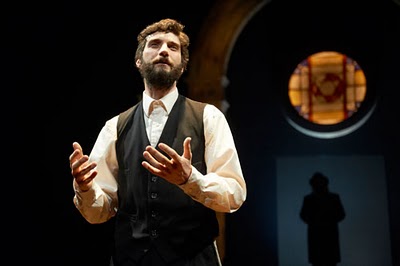
My Name is Asher Lev (Play Review ~ and Spoiler))

Last night, free tickets in hand, Gregarious Son and I went to see the Cleveland Playhouse's performance of My Name Is Asher Lev, based on the Chaim Potok novel with the same title.

Having taught in an Orthodox Jewish school for several years, I have read much by and about Chaim Potok.  This work follows a familiar pattern: the story of an observant Jewish boy pulled between the rich and demanding tradition of his faith culture and the rich and demanding tradition of another world as he grows into manhood.  In The Chosen, the best known of Potok's novels, the conflict forms the life of Danny, the brilliant son of the rebbe who raises him in silence, so that he will know the pain his father sees as essential to his becoming a legitimate and compassionate leader of his people.  Danny leans, however, toward the new field of psychology, and the contributions of Jewish but atheist Freud, and eventually leaves the Brooklyn yeshiva world for the secular environment of Columbia University.

Asher Lev's gift lies in painting, a completely unacceptable pursuit in the eyes of his Hasidic father, who expects him to study Torah and live the strict life of the most radically observant of Torah Jews. Thanks to their rebbe, the unquestioned leader of their small community, Asher receives an introduction to the painter ~ Jewish but not observant ~ who agrees to train him for five years, beginning, significantly, in his Bar Miztvah year.  Jacob Kahn, the painter, reminds Asher repeatedly that he is entering the world of the goyim, that his path will be one of pain, separation, and isolation ~ within his family, within his community, and within himself.  The two of them make an intriguing pair, Jewish men seated in art museums, studying and copying the work of the great masters, whose subject matter largely concerns the Christian narrative.

One of my favorite lines in the play comes from Jacob Kahn, who tells Asher that he must learn the tradition ~ Titian, Michaelangelo, the other greats of the Renaissance ~ before he can add to it or rebel against it.  Applicable to all of us, in all traditions.

The gulf between Asher and his religious family and community widens as he pursues his work, learns to paint nudes, and becomes the source of increasing conflict between his parents.  Commercial success does not diminish the interior anguish that propels his work, much of it rooted in his understanding of his parents and their world. The final denouement comes after he visits Italy and becomes absorbed in its art, particularly the Pieta.  He returns home to paint the pieces that will both seal his reputation as a great artist and drive him from the community that sees his work as the ultimate betrayal.

The performances were wonderful, and I left with two intensely personal reactions.  First, I felt carried back to my teaching days in the Orthodox community, to my memories of life in a culture distinctly different from my own but that has nevertheless shaped many of my ideas about community, identity, and God. I was not surprised to discover  the name of one of my former colleagues on the program, a rabbi and high school teacher who served as a consultant to the production.

Secondly, I awoke this morning pondering the final crisis of Asher Lev, which leads him to paint a crucifixion with his mother as the subject and his father and himself, the two poles of her life, standing on either side of her outstretched arms.  The subject matter, the crucifixion itself, is profoundly off-limits to an observant Jew, but Asher says that he could not find in his own tradition an adequate rendition of the suffering of his mother, who has lost much (parents, brother, and now his own presence)  in her lifetime.  I was quite taken with how, as an outsider to the Christian tradition ~ and not just an outsider, but an outsider to whom the cross is particularly abhorrent because of the avalanche of horrors it has unleashed upon his people ~ not only could he interpret a Christian icon of such significance in such a deeply personal way, but he could find within himself and his own story the freedom to interpret it so fully, by placing the small and yet powerful feminine figure of his mother at the center.

The word tradition is at the heart of this work ~ the tradition of the Torah world, the tradition of the artistic world.  (One can practically hear Tevye.)  Asher Lev is the outsider and participant in both, reminding us that the vision of a community and its work depends upon the mingling of perspectives of both those within and those without.

Terrific play.


Image: Noel Joseph Allain as Asher Leve, here.