Showing posts with label Jewish. Show all posts

Monday, June 16, 2014

Sitting Shiva

I realized that the living room had grown silent as I told the newly bereaved mother what little I know about suicidal states of minds. 
 
Mostly I told her that, while scripture tells us to "Choose life," people who die of suicide are not un-choosing it.  They are choosing to end the pain, not to die, and they don't really understand, according to my son's therapist, that they will not be here tomorrow with the people they love so much.  The tunnel vision, the fog created by pain and despair, take over, and they forget how much they are loved and how many people would do anything at all to save their lives.
 
I gave this Orthodox Jewish mom, with whom I used to discuss the academic progress of her children, my card, and told her to call me, not as a pastor, but as another mom.
 
Dad of Best Friend followed me out of the sweltering house to ask more questions.  "These kids," he said, "they're all blaming themselves."
 
Yes. 
 
It's been a long time since I've been at an event at which the men go into the living room to daven (pray) while the women, dressed in long skirts and long sleeves despite the oppressive humidity, stand around in the kitchen and wait.
 
I liked it so much better before, when my expertise was world history and not suicide.


Sunday, June 15, 2014

My Jewish Life

After I learned of the death of my former student on Friday, I went to the memorial FB page to post my condolences and to add a portion of a piece I'd blogged some years ago.
 
Those posts garnered me a lot of parent and student "likes" and some new friend requests, from people with names like Hannah and Issac and Noah and Ariel and Yael and Chava and Hadas and Avital and Liat.
 
The circumstances are heartbreaking, but it's a pleasure to see the names of those beautiful young people and recall another life. 

Saturday, June 14, 2014

Too Much

Yesterday the Huffington Post published a piece they'd invited me to write in response to a TED talk about suicide.  I decided to write about things I thought might help survivors -- not a religious post, not a post filled with pastoral reflections or exhortations - just a post about some of what I've learned, written by a mom survivor who happens to be a pastor.

Positive responses poured in.

Among them was a repost by a former teaching colleague on a memorial FB page for a former student of ours.  Unbeknownst to me, he had died of suicide two days previous.  Twenty-four years old.  What I remember is his relentless sense of humor as he failed, time and again, to turn in his work.   Jewish funerals take place within 24 hours of a death, so I missed that, but she and I will go over to the house together on Monday.

Another response came from a high school classmate, about a series of suicide-attempt related losses all those years ago.  I did not know about those events, but I recognized the emotional landscape of which she wrote.


Then, today, the wedding of our next-door neighbors' middle daughter.  I tried; I really did.  I do not want to be like the father who wrote the column a year or two ago about not having attended a wedding in the eleven years since his son died.  I want to help my friends celebrate the great events of their lives.  This was our fourth try.  We haven't made it all the way through a single reception.  Tonight's final straw came when the bride's two sisters and brother sang "Here, There, and Everywhere" to her.  Before dinner, I might add. The seven children of our combined families played together for years; both families were filled with joy and laughter.  Theirs still is.

A new friend is doing the Overnight Out of the Darkness Walk in Seattle tonight, in honor of her son who died just a year ago, on the morning of his high school graduation day.  I had toyed with the idea of going to that walk (in one of my favorite cities) - until I broke my ankle.  I wish I were there anyway.

I am completely depleted.  Whatever I wrote about finding hope, whatever courage people saw in that   piece . . .   . Not tonight.  I just want my son back. That's the only thing I ever really want.

I can't imagine how I am going to lead worship tomorrow morning.  One of these days I'm going to have to preach so far ahead of myself that I'm going to fall flat on my face.


Saturday, July 27, 2013

48-54/60


2004 Thanksgiving in Chicago

Phew!  All three kids made it to college and stayed there until diplomas were in hand.  Those years meant trips to Chicago and New Orleans and Oregon for us, studies and travel in Europe for the boys, camp counseling in North Carolina for two of our three, and a trip to Iona and France for us.  Two days in Chartres a block from the Cathedral!

A major life transition for me, as I switched from law to teaching history and literature in a Modern Orthodox Jewish day school.  Immersion into an entirely new-to-me culture. There are several Orthodox neighborhoods in the Cleveland area, including some close to ours, but I knew nothing of life there ~ the religious observances, the focus on Torah, the food and celebrations, the academic expectations, the family lives.  Six years in and out of a different world on a daily basis.

Several worlds, in fact.  This was also the period in which I made the Spiritual Exercises of St. Ignatius. I've written about that year so often here that I won't elaborate further today, except to say this:

I was 52 that year.  I can't put my finger on any explanation for my being so open to new experience and deep prayer in that particular year, but in retrospect the whole experience was a powerful confirmation of how profoundly one's approach to life can change, or be changed, at any time.  As I sit here writing on my laptop in my comfortable living room in Ohio in 2013, I think of Ignatius in Spain in the early 1520s, beginning to formulate what would become his little guide to prayer for those who would accompany others as he was beginning to do.  Had he not been slammed by that cannonball and had I not bumped into a wise elder of his Jesuit order nearly 500 years later, would I have become a spiritual director?  become a pastor?  survived Josh's death? 
 
Probably not.
 
Here's what I think about life from the vantage point of sixty:
 
Very strange.


Tuesday, October 23, 2012

Looking Back

A couple of weeks ago I was invited to emcee an event next April: the dinner celebration of the tenth anniversary year of the Ignatian Spirituality Institute, the program in which I studied spiritual direction. I started wondering what I had been up to during the April in which I was making the Exercises, and dug back through my journals to see whether I could uncover something that might help me introduce the event.  (I may have.)  

Then, as long as I had my file boxes of prayer reflection journals out (twenty-some over the past eight years!), I wondered what the October entries would show.  How life has changed  .  .  .   .

October 19, 2005

A few weeks into the Spiritual Exercises, which means that I have made a commitment to an hour or so of prayer time each day (I am nowhere close to meeting that commitment) and a weekly meeting with a spiritual director, who is very gentle and very funny, and takes my beginning efforts very seriously.  Recently returned from visiting Josh at The University of Chicago.  I am an elder in my home Presbyterian church and a teacher in an Orthdox Jewish school, and my life of prayer is in its infancy.

" 'Be still and know that I am God.'

Really, these are words that you could put into use anywhere, any day, in the middle of anything.  Staring with the 'be still.'  Meaning: Create an interior stillness.  Lose all the internal chatter.  That in itself would be a discipline.

Just right now: I can hear the tv in the living room, the dog walking around hopefully in the kitchen, the clatter of these [computer] keys.  But I can try to create an inner stillness.  A hollow place.  Not an empty place, but a warm, hollow, inviting place for God to rest.  How would I do that during the day?"

October 17, 2006

The Exercises are, officially, behind me, and have become the framework for my spiritual life.  I am embarking upon the ordination journey, and have just been endorsed by the Session of my home church as an Inquirer in the official process.  I'm visiting and applying to seminaries, and there's no reason to think that all will not go splendidly.

In my journal: A brief email exchange with my spiritual director on the continual dilemma in my life: Protestant/Catholic; Ignatius/Calvin (both studying in Paris in the 1530s, where I spent time in July imagining them both).  He has some reading suggestions. 

October 20, 2007

I am a brand-new new seminary student, reflecting on the Eucharist, which had been transformed for me the previous year from a boring ritual to a deeply significant sacrament, thanks to a Seder dinner at the home of one of my students, a meal shared in the context of Week 3 of the Exercises with its many imaginative prayers based on Jesus' final days.

"The seminary feels physically bereft to me.  No labyrinth.  No stained glass.  No statues.  No art. Puritan starkness in the extreme  It has its own beauty but it seems, as a day-after-day-after-day experience, on the empty side.  I begin to see how much I depend upon material, substantial reference points for faith."

Mid October, 2008

The entries are not dated, but they are stacked in order in a folder.  Josh has been gone for seven weeks.  My father thinks his cancer had recurred.  (It had not.) Spiritual director emeritus does have cancer.  ( From which he eventually recovered.) How much? I wondered, sitting in my living room late in the afternoon, hair dripping from the shower, looking in despair at the emails on my laptop. 

"What does it mean that people keep speaking and writing to me in this way -- you teach us so much, you will have more wisdom and compassion for others?  Does it mean that even in the midst of such a horrific loss, I am still called to serve?  Even though I am now a person who can barely get out of bed in the morning?  A person who could not be trusted with the life of her own child?"

October 19, 2009

I am back in seminary.  I am taking Worship and Sacraments and Hebrew Exegesis and something else (I have no idea what that might have been).  This is the fall that I spend almost entirely on Psalm 88, which probably helps to save my life.  

In my journal: A long email received this day from SDE, which I carried around, crumpled up in my pocket, for months, because I needed to read and re-read what was, in effect, an extended meditation on the Suscipe,  a prayer at the end of the Spiritual Exercises.  He writes, among other things, about coming to an acceptance of the mystery of faith.   I will get no answers, he tells me.  It is oddly reassuring, to be offered companionship in the articulation of that hard reality. 


Not a bad re-read this week, as I am contending with Job in the pulpit.  Odd, to look back at these entries from this vantage point.  What a terrible and strange and wonderful journey this has become.


Thursday, December 8, 2011

Christmas: Fragmentation and Wholeness


I've been thinking about Advent and Christmas for awhile, but the thoughts below finally crystallized as my own version, or response, to this post in Blue Eyed Ennis.  One of the things I enjoy about blogging is the ways in which unexpected conversations take place across time and geography ~ Blue Eyed Ennis quotes Dating God ( a recent and favorite discovery of mine), which quotes Thomas Merton, who says, 

"The certainty of Christian hope lies beyond passion and beyond knowledge. Therefore we must sometimes expect our hope to come in conflict with darkness, desperation and ignorance." (See Blue Eyed Ennis for the entire and quite wonderful essay.)


My contribution to the conversation:

I could just - not. I could just not do religion.   I could have left seminary.  I could have finished my degree and decided to take on only work in which Christmas was not a feature.  Something academic, perhaps.  I could revert to the stance of my family of origin, which has generally been that life without faith is much easier than life with.

I did some bizarre things during the sleepless nights that became my lot after Josh died.  One evening, I spent hours and hours online reading everything I could find about the response by people of religious faith to death from suicide.

In one sense, it didn't matter.  Had I found nothing but condemnations of suicide victims to hell, I would have walked away from the church with nary a second glance.

In another sense, it did matter.  I heard nothing other than words of comfort from those in my life connected with both  Jewish and Christian religions, and I was well aware of mental illness as a factor in suicide, but I had been teaching history, and studying world religions and religious history, for years.  I wanted to trace the history of the religious response; how had it changed since the Middle Ages so that rabbis and priests alike could offer words of reassurance to me? What was going to make it possible for my own pastor to preach a funeral sermon affirming the resurrection of the dead?

When our children were young, and then older, Christmas was a magical time.  Family magic, as we created and followed a plethora of traditions that filled our lives with humor and joy. Friend magic, as we participated in the events others hosted and opened our own doors to a dinner for as many as ten or twelve families celebrating both Christmas and Hanukah.  And yes, a  sense of religious magic, in Services of Lessons and Carols and watching Amahl and the Night Visitors and helping to produce The Best Christmas Pageant Ever and Christmas Eves filled with music and candles and a sense of the Holy among us.

All gone.  Just.like.that.

Like so many families whose children have died, we turned our backs on all that we had known and created and treasured, unable to bear the associated anguish, and traded snow for palm trees without a glance backward.

Each year, the ground shifts a bit, and the path widens.  Or changes.

This year, we'll be at home.  Worship services for me to lead on Christmas Eve and Christmas morning, and today we decided that in the afternoon we will join our friends for the annual dinner that migrated elsewhere when we headed for Key West.  I expect it to be a fairly difficult couple of days, with my own feelings somewhat mitigated by the requirement that I put many others ahead of myself.

But something else is changing as well.

It seems that when the beloved traditions are no longer tenable, when they become cherished memories no longer manageable, there are two choices.  I could turn my back on all of it.  (That first year, we came up with Baghdad and Pakistan as potential destinations, so eager were we to escape Christmas.)

Or . . .

I could focus more deeply than ever on the reality behind the traditions.  As wonderful as they are, or were ~ the lights, the gingerbread, the candles, the crafts, the trees, the baking, the presents, the music, the togetherness ~ they all serve as a front for the reality:

The embodied presence among us of a God who comes to save us, a God whose love is so great that it sweeps all of us into one great embrace, a God who sends a son to live and suffer as we do to ensure that, in the end, we will live but suffer no more.

Advent is a time in which it seems that my personal experience of loss knows no bounds. For me, personally, the cultural holiday glitz is the equivalent of 40 days in the wilderness.  But if Christmas is, indeed, the first step toward Easter, then it is also the day on which we should register our desperate, agonizing losses as those of perishable bodies that will be changed in the twinkling of an eye.  We will be changed, because death will be swallowed up in the victory of the small and vulnerable Christmas infant.

Christmas seems very possible when I look at it that way.


Image: Mary in the Storm by Patricia Brintle, a friend of a friend and  my favorite artist tonight.

Saturday, November 5, 2011

Breaking Bread with Online Friends


"How do you know all these people?" exclaimed a friend last night, when I stopped by her house to wish her a happy birthday.  "You had a rabbi from St. Louis and a photographer from Philadelphia at your ordination - how did that happen?"

A couple of years ago one of my seminary professors expressed great skepticism about internet interactions and friendships.

Let's see . . .

Carol isn't a rabbi, but she is a dear friend (unmet in real life until last Sunday!) as a consequence of fifteen years of emailing among a group of moms who met online.  Carol and I have enjoyed numerous discussions about Jewish-Christian matters over the years and she has been a rock in my life since Josh died.  Of course I wanted her to read Psalm 139, and to read at least the first few lines in Hebrew.

Michelle isn't a professional photographer, but she's a contemplative one, as well as a chemistry professor and essayist on the spiritual life.  We met online through our mutual passion for blogging and Ignatian spirituality, and we've met at Wernersville, a place of silence and prayer to which Michelle heads frequently and I, once a year.  We blogged our way through Into the Silent Land Together (see top of page), and we've shared many conversations, both intense and humorous. 

Another online and now in-person friend who appeared is Chris.  We met because an article appeared in the local paper a few weeks after Josh died, a year after her daughter died in Italy.  We've walked along Lake Erie together and we've shared many challenging and loving conversations with two other heartbroken mothers, all of whom met through our blogs andall of whom eventually spent months in an online retreat together, reading and writing about a Joyce Rupp bookr.

I'm realizing as I report on these friendships that perhaps they are not so much online friendships as writing friendships.  Carol mentioned that many of her friends at home expressed skepticism about her trip out here; many of my friends also roll their eyes at the mention of internet relationships. 

But the reality is that years of shared correspondence ~ whether high tech or via the old quill-and-ink method ~ produce deep reflection, intimate sharing, and lasting friendship. 

The image is Michelle's ~ My First Celebration of Communion.

Thursday, September 29, 2011

Shana Tova!


In a perfectly wonderful confluence of events, the Jewish New Year started Wednesday night and today is the Feast of the Archangels in the Roman Catholic Church.

When I taught in the Jewish school, I had students named Gabe, Gabriella, Michael and Rafi.  

The Lakeview Cemetery images above are of Michael the Archangel (two details) and, I presume, due to the trumpet, Gabriel.

Since this whole cancer thing began, I have had emails and calls from Jesuit friends telling me that they are praying for me when they celebrate Mass, and a FB  message from my friend Carol that she remembered me in her Rosh Hashanah mishebeirach (healing) prayer.  (You should see the photo of her beautiful dinner table.)

Last night I went to the session/council meeting of my new church and came home assured of many Presby-Methodist prayers (and feeling like a pastor!).

And I know that there are other Jewish-Catholic-Protestant-of-all-flavors prayers floating around out there, because people keep writing and telling me so.

There was also Rosh Hashanah chicken soup on my back porch when I got home awhile ago.   And Ignatian tea and jam and chocolate in the mail.

Thank you all so very much. You make cancer a small thing and friendship a great one.


Friday, June 24, 2011

Friday Five Faith and Culture Edition


 A terrific Friday Five from Terri today! She writes as follows:

This week the church I serve is a host site for the University of Michigan, Dearborn, Worldviews Seminar. It's a week long summer education course open to anyone, with continuing ed hours to be earned. It's a survey of the world religions with a morning lecture at the university, led by Lucinda Mosher. Then the group drives over to the church for lunch, a short lecture, and then they board a bus for a tour of local religious buildings. They tour Buddhist temples, an Antiochean Orthodox church, a synagogue, a mosque, and many other area houses of worship.This year is the tenth anniversary of the seminar.

In addition to the Worldviews Seminar the congregation I serve is planning to participate in Episcopal Faith Shared and Faith Shared. I am working to have members of local Jewish and Muslim congregations present and participating in our Sunday morning service.

So, in honor of a week of interfaith study and celebration:

1. Have you ever had an experience of a religion other than your own? And, if so, what was it like for you to experience something different? If you haven't, what religion might you like to study, experience, and learn more about?

I spent six years teaching in an Orthodox Jewish day school, which was like entering another culture each morning.  Since I taught literature and world history to intensely curious students who seldom encountered anyone outside their own community of faith, we had some wonderful conversations about belief, practice, and culture.  Typical ninth grade questions:  Why are Christians polytheistic?  Why does Mel Gibson hate us?  Do you really believe that Jesus rose from the dead?  And what's with those pumpkins on Halloween?  The whole experience was challenging, often disconcerting, and led to wonderful friendships with students and teachers.  As usual in such situations, I learned far more than I taught.  Probably the most important thing I learned is how much respect is generated when people adhere faithfully to their own beliefs while maintaining a stance of openness and generosity to others of different traditions

2. Have you ever studied, traveled, or explored other cultures? What and where, and when?

Most of my travel has been either in the United States or Europe, so I can't say that I've been far afield, culture-wise.  However, when our son Josh spent his 11th grade year in France, we  got a tiny taste of French life and culture through the time we spent with his family there.  I have maintained a warm relationship with his French mother and brother for the past almost-ten years, despite our infrequent communications and the tragedy we have all shared.  Gregarious Son leaves for a law student program in Novgorod and St. Petersburg day after tomorrow, so we're about to learn something about Russian culture ~ I hope!

3. Any stories you wish to share about a person (author, teacher, etc), or a friend or colleague, from another culture or religion, who has impacted you in some capacity?

The rabbi who was the principal of the aforementioned school had a big impact on me.  His own pre-college education had taken place entirely in the black hat yeshiva world; his high school friends considered him in danger of worldly influence when he decided to attend Yeshiva University in New York City -- a bastion of Orthodox Judaism from most points of view, but in theirs, a hazardous place in which people study law and medicine and secular  literature as well as Torah.  He explained once that his parents, while deeply religious, were also brilliant, alert, and attentive to the world around them.  The mix of worlds produced a quietly compassionate and effective man, one who could talk with authority on almost any subject, was genuinely curious about everything, and was universally respected by those he encountered across a wide spectrum, from teenagers in trouble to adults who had far-ranging educations and life experiences of their own.  He and I had a number of fascinating conversations over the years.

*****

I started this entry early this mornng but ran out of time before I had to leave for a meeting.  One of the pastors from my field ed church of year before last recently invited me to join the board of a nonprofit that promotes interfaith dialogue.  That organization is one of a number co-operating on an interfaith commemoration on 9/11, which is how I found myself hosting a meeting of the publicity committee this morning at my home Presby church, a committee whose membership is Hindu, Muslim, Buddhist, Jewish and Christian!

Friday, June 10, 2011

Conversion Takes a Lifetime

A few months ago, The Lovely Daughter, midway through graduate school, advised me as follows:

"I think it's hopeless, Mom.  If people don't believe in God by the time they reach adulthood, it's not gonna happen."

"Not so," I responded.  "I was well into adulthood before I thought there might be a God. "

"Really?" She looked at me skeptically.

"When I was your age, I never gave any thought to God.  And if anyone had asked, I would have described myself as an atheist."

I'm not sure that she believed me.  But our conversation came to mind as I drove down a street in a neighboring suburb last night and saw a law school classmate walking home from Shavuot services with a friend.

In law school we knew one another well -- our last names start with the same letter and so we were placed in the same section of our course in legal research, writing, and advocacy, thus becoming members of a small group destined to spend many of our waking hours together for our first year.  As far as I know we both lived lives that were basically secular:  culturally identifiable as Jew and Christian around our respective holiday times, but otherwise indistinguishable in our lives from others who had no religious affiliation of any kind.

Today she is an observant Orthodox Jew.  Her husband is one of the city's most successful businessmen, and they are major supporters of many major Jewish projects and institutions (including the Orthodox day school in which I used to teach).  She looked great last evening, her long skirt swinging well below her knees and a boyish cap topping her blonde curls.

And today I'm a spiritual director and a candidate for ordination in my denomination.  I have a lot more flexibility in my attire than she does, but the invisible changes in the religious landscapes of our lives are remarkably similar.  And from our conversations over the years I taught school, I'd say we are both engaged in a lifetime experience of growth toward God.

Nope, LD, there is no timetable for religious conversion.

Saturday, March 26, 2011

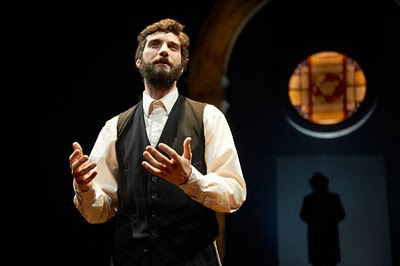
My Name is Asher Lev (Play Review ~ and Spoiler))

Last night, free tickets in hand, Gregarious Son and I went to see the Cleveland Playhouse's performance of My Name Is Asher Lev, based on the Chaim Potok novel with the same title.

Having taught in an Orthodox Jewish school for several years, I have read much by and about Chaim Potok.  This work follows a familiar pattern: the story of an observant Jewish boy pulled between the rich and demanding tradition of his faith culture and the rich and demanding tradition of another world as he grows into manhood.  In The Chosen, the best known of Potok's novels, the conflict forms the life of Danny, the brilliant son of the rebbe who raises him in silence, so that he will know the pain his father sees as essential to his becoming a legitimate and compassionate leader of his people.  Danny leans, however, toward the new field of psychology, and the contributions of Jewish but atheist Freud, and eventually leaves the Brooklyn yeshiva world for the secular environment of Columbia University.

Asher Lev's gift lies in painting, a completely unacceptable pursuit in the eyes of his Hasidic father, who expects him to study Torah and live the strict life of the most radically observant of Torah Jews. Thanks to their rebbe, the unquestioned leader of their small community, Asher receives an introduction to the painter ~ Jewish but not observant ~ who agrees to train him for five years, beginning, significantly, in his Bar Miztvah year.  Jacob Kahn, the painter, reminds Asher repeatedly that he is entering the world of the goyim, that his path will be one of pain, separation, and isolation ~ within his family, within his community, and within himself.  The two of them make an intriguing pair, Jewish men seated in art museums, studying and copying the work of the great masters, whose subject matter largely concerns the Christian narrative.

One of my favorite lines in the play comes from Jacob Kahn, who tells Asher that he must learn the tradition ~ Titian, Michaelangelo, the other greats of the Renaissance ~ before he can add to it or rebel against it.  Applicable to all of us, in all traditions.

The gulf between Asher and his religious family and community widens as he pursues his work, learns to paint nudes, and becomes the source of increasing conflict between his parents.  Commercial success does not diminish the interior anguish that propels his work, much of it rooted in his understanding of his parents and their world. The final denouement comes after he visits Italy and becomes absorbed in its art, particularly the Pieta.  He returns home to paint the pieces that will both seal his reputation as a great artist and drive him from the community that sees his work as the ultimate betrayal.

The performances were wonderful, and I left with two intensely personal reactions.  First, I felt carried back to my teaching days in the Orthodox community, to my memories of life in a culture distinctly different from my own but that has nevertheless shaped many of my ideas about community, identity, and God. I was not surprised to discover  the name of one of my former colleagues on the program, a rabbi and high school teacher who served as a consultant to the production.

Secondly, I awoke this morning pondering the final crisis of Asher Lev, which leads him to paint a crucifixion with his mother as the subject and his father and himself, the two poles of her life, standing on either side of her outstretched arms.  The subject matter, the crucifixion itself, is profoundly off-limits to an observant Jew, but Asher says that he could not find in his own tradition an adequate rendition of the suffering of his mother, who has lost much (parents, brother, and now his own presence)  in her lifetime.  I was quite taken with how, as an outsider to the Christian tradition ~ and not just an outsider, but an outsider to whom the cross is particularly abhorrent because of the avalanche of horrors it has unleashed upon his people ~ not only could he interpret a Christian icon of such significance in such a deeply personal way, but he could find within himself and his own story the freedom to interpret it so fully, by placing the small and yet powerful feminine figure of his mother at the center.

The word tradition is at the heart of this work ~ the tradition of the Torah world, the tradition of the artistic world.  (One can practically hear Tevye.)  Asher Lev is the outsider and participant in both, reminding us that the vision of a community and its work depends upon the mingling of perspectives of both those within and those without.

Terrific play.


Image: Noel Joseph Allain as Asher Leve, here.

Sunday, June 13, 2010

Sunday Stuff

~ Went to my home church today.  We were honoring graduates, so I got some nice hugs. 

~ The gospel text today is the story of the "sinful" woman in Luke who weeps and kisses Jesus' feet as she anoints them with oil and wipes them with her hair.  (During Lent, I preached on the version of this story that appears in John's gospel.) Four reasons why I love my church: (1) In her introductory remarks, one of our pastors made the point that whenever Jesus interacts with a woman, something significant is going on, and since this story of his interaction with a woman is told in in all four gospels, we are talking major significance.  (2) I can characterize her remarks as "introductory" because today the sermon was a congregational group discussion rather than a pastoral homily.  (3) One of the folks who spoke up said that she thinks that Jesus and this woman must have had a previous encounter, and always wonders about that back story.  (Great sermon topic there.)(Or discussion topic.)  (4)  Instead of the usual focus on forgiveness that this story generates, our emphasis this morning was on Jesus' extension of inclusion in community. All good stuff, all hallmarks of our church.

~ One of Josh's high school teachers and his wife have recently joined our church, and so I pulled him aside to talk to tell him about Josh.  As it turned out, he knew that Josh had died, but not how.  The strangest thing: after a conversation like that, I always think: OK, all done; he'll be back tonight.

~ I am trying to create an account so that I can sign up to re-take my Exegesis exam.  The length of confirmation time is not bolstering my confidence in the PC(USA) capability for online registration.

~ I am also trying to get my passport application finished.  I realized last week that I can't just dash up to Algonquin to scatter ashes because my passport is no longer valid.

~ My hair is much shorter and browner than it was at my graduation a week ago.

~ I am going to another graduation today, that of the Jewish school at which I once taught.  In fact, I taught all of the seniors who were there then in both 8th and 9th grade, so I know them well.   There will be some screeching.  "Ms. Craig!  Ms. Craig!  Are you a rabbi yet?!"  Well, no ~ there is this little matter of YOUR language . . .       .

~ My father is quite ill.  My family's dynamics are challenging at their best, but I will probably plunge into the middle of them later this week.

~ Another good thing about my church: our summer lay preachers series.  (How I got started in the pulpit!)  A friend sent me his first sermon draft ever a few hours ago.  I must be at a new place, if people are sending me drafts to critique.


~ My imaginary walk has gotten me to Nauset Beach.  Another scene of high school adventures.  I could never stand up on a surfboard, so maybe misadventures is the more appropriate term.