Showing posts with label Into the Silent Land. Show all posts

Sunday, November 3, 2013

Silence and Saints ~ Sermon (I Kings)

Cemeteries are usually silent places, aren’t they?  Not always – sometimes bands and speakers and Scouts appear in cemeteries, to celebrate Memorial Day, or another significant event – but on the whole, cemeteries are silent.  Quiet places, places in which we go to visit our dead, to remember them, to speak with them.  Silent places in which we commune with both God and with our beloved departed, as we do on this particular day of the church year.
Thin places.    It was the Celts, those tribes who covered much of western Europe centuries ago, who are most closely associated today with Scotland and Ireland, who coined the term ”thin places” to describe those sacred places in which it seems that heaven and earth almost kiss one another.  Places in which it seems that God is especially close.  Places often wild and remote, deserts and heaths and tundra, where God’s presence seems particularly compelling.
Some thin places are recognized the world around:  the Isle of Iona, off the coast of Scotland is one.  The labyrinth, a hundreds-years-old stone walking path in Chartres Cathedral in France.  Ghost Ranch, a retreat center in New Mexico. Mount Sinai, where Moses received the Ten Commandments.
Others might be personal to each of us.  Perhaps some special place that has come to have significant meaning for us as a locale and which we and God have found one another.  Perhaps a place like a cemetery.  A place in which the connection to God and to the next life, the life in which all is re-created and healed, seems especially intense.
For the prophet Elijah, the thin place is just outside a cave on Mount Horeb.  The Israelites whom we’ve been following for several weeks are settled in their Promised Land, but conflict is not at an end for them – especially not conflict with those who worship other gods.   And so we catch up with Elijah on the run; he has destroyed – literally – the prophets who have served the gods of Queen Jezebel, and she has vowed revenge upon him, and he has hightailed it for the wilderness. Scared and all alone, he has consigned himself to death, when an angel of the Lord appears and provides him with food and drink for the journey ahead.  And then, after he spends another night on his own, this time in a cave, he hears God’s instructions: Go outside; I am about to pass by.
God does not, however, come in the way in which Elijah expects.  Not in the wild wind, not in an earthquake, and not in fire – not in all the signs of power and majesty that might be expected.  No – God comes in the sound of silence.  A sound of sheer silence; a sound of thin silence.
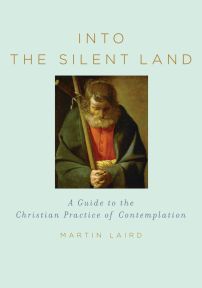
We know, from our 2,000 years of Christian history, that God often speaks to us in the silence.  We remember that Jesus often went aside to pray, alone and in the silence, especially as he faced major decisions and events. We know that men and women in the early centuries of Christianity headed out to the desert, to listen for God in the thin silence.  And as Father Martin Laird, author of that most wonderful book on prayer entitled Into the Silent Land reminds us, we encounter God in the stillness, where we see “that there is something utterly vast and sacred within is,” a silent land in which God awaits our attentiveness. 
Today, as we celebrate All Saints’ Day, that day of the church year on which we pause to honor all those who have followed Jesus from this world into the next, we celebrate first in silence.  We remember the many who have led the way for us:  parents and grandparents, those who first exemplified the Christian life for us.  We remember many who have accompanied us:  brothers and sisters and friends, those with whom we have shared our lives of faith, those with whom we have shared our questions and our hopes, our doubts and our convictions.  We remember many who left us too soon: children and others whose lives seem to have been incomplete, those with whom we had expected to share much more of God’s bounty and abundance. 
And most particularly, we recall those who died in this past year.    Members and friends of this church and of our community, some of whom we knew well, and others who touched our lives through relatives and neighbors.  Today, not in a cemetery but here in church, we will light a candle for each of them, remembering them in the silence in which God speaks so profoundly. 
And then – then we will remember and share a communion meal with them.  Every time we gather at the communion table, we encounter a thin place and we feast with those already feasting with God, already healed and whole and experiencing joy through the Spirit in the presence of our Creator and Savior.   
So let us honor our saints, those we name today and those whose names we carry in our hearts, first in silence and with candlelight, and then in joyful praise, thanksgiving , and song, as we share in the meal served to all by Jesus Christ.  Amen.

Monday, April 29, 2013

Into the Silent Land Revisted


Martin Laird, O.S.A., journeyed to Wernersville last week-end to lead a two-day contemplative prayer retreat ~ for me, the retreat within a retreat.  Ninety people, probably all of them familiar with his books, Into the Silent Land and A Sunlit Absence, showed up to listen to his presentations and to spend time in silence with one another.
 
(Michelle and I spent some months awhile ago blogging back and forth about Into the Silent Land; those posts remain linked in my bar above.  I've read A Sunlit Absence as well and, to tell the truth, I couldn't make head nor tail of it.  I will probably give it another try soon.)
 
I thought I'd offer just a very few vignettes from the presentations, and explore them in more detail later, as I sort through my own prayer and reactions. I'm using quotation marks even though these are not verbatim quotations; they're close enough, and I want to indicate that the source is Martin Laird rather than myself.
 
*****
 
"Inner silence constitutes inner spaciousness."
 
"In our spiritual lives, we are like someone fishing for minnows from the back of a whale ~ sitting on the greatest catch of all, and yet satisfied with something puny."
 
"You will know that you are in the countryside of prayer when you experience joy and reverence at the same time." (That one comes from Evagrius rather than from Marty Laird.)
 
"The purpose of the Christian life is to open the eye of the heart, where God may be known." (That was one of Augustine's contributions.)
 
"In the practice of contemplative prayer, we move away from the chatter of discursive prayer in our heads in which, no matter how dreadful the narrative, we always have the starring role."  (A Laird riff on Evagrius, which I found hilarious, and oh-so-true!)
 
*****
 
As you might be able to tell, the presentations were divided roughly into material on the history of Christian contemplation and reflections on its actual practice.  Marty Laird is the master of metaphor, and listening to his measured, unhurried  observations is itself an exercise in contemplative prayer.
 
I've studied a lot of the material he presented and I'm somewhat familiar with the development of contemplative prayer in the Christian tradition.  (And even in my Presbyterian seminary, we were offered a tinge of an introduction to the desert fathers and mothers in the context of our church history sequence ~ a linear and factual introduction, not an invitation into the spirituality of the desert by someone who had himself delved deeply into its pathways.)  But to hear a master of the tradition, someone who has spent his life exploring its nooks and crannies, bring it to life is to be yourself immersed, however briefly, into that sea of prayer.
 
*****
 
We do, in reality, mostly relax in our beach chairs on top of the whale.

Tuesday, July 5, 2011

A Sunlit Absence - I (Book Review)


After months of eager anticipation, I have zipped through Martin Laird's A Sunlit Absence: Silence, Awareness, and Contemplation and begun, as of late last night, a much slower and more careful second read.

A Sunlit Absence is a companion volume to Into the Silent Land: A Guide to the Christian Practice of Contemplation, upon which Michelle and I reflected  over a period of several months last year. (See tab at the top of the page.)  I think that most readers will find A Sunlit Absence to be more challenging and, without a great deal of attentiveness paced over an extended period of time, less easily satisfying,  On the other hand, of course, perhaps such attentiveness will lead ultimately to a more rewarding experience of reading and prayer over that longer timespan.

Into the Silent Land, using the metaphor of the doorway, provides an introduction to contemplative practice in the sequence of a journey.  Moving from an introduction to Christian contemplation into the methodology of utilizing a prayer word, addressing the difficulties with mental distractions that cause many people to run as fast as possible away from anything that smacks of silence, and providing instruction in how to persist in prayer despite or even in aid of life's traumas and crises, Into the Silent Land eases us into an orderly exploration of prayer.

A Sunlit Absence is more akin to the experience of opening a scrapbook, inviting us to sift through a cascade of images, allusions, and parables in pursuit of the elusive God who need not be pursued at all because we live and move and have our being, always, within God's love.  I've just counted, and I have at least 25 of its 175 pages turned down as indications of material that called out to me for further reflection ~ but I don't yet have a sense of the whole.

The title of  the book comes from a Seamus Heaney poem which begins with the words, "There was a sunlit absence."  I'm not sure that Laird ever addresses the poem (as I said, my first read was a speedy one), but what he does describe in the introduction  is our experience of the God who both envelops and fills us as  that of water merging into water and light merging into light.  As Teresa of Avila says, "love melts into love."

As I pondered some days ago, before the book arrived, I have begun to wonder whether the silence of God is not, in fact, the compassion of God.  When I mentioned that possibility to someone else, he suggested that the silence of God is the patience of God ~ and, perhaps not surprisingly, referred me back to a passage in Into the Silent Land.  

I have been wondering, also, whether the silence of God perhaps reverberates through the universe?

Silence as the compassion of God, the patience of God, the echo of God?  We shall see what this book suggests.

Monday, March 21, 2011

Lenten Break

"We are built for contemplation."

~ Martin Laird, OSA
Into the Silent Land
 
Image: Cedar Key FL

Wednesday, March 16, 2011

Supporting Silence

As you may know from one of the tabs at the top of my blog, my friend Michelle and I invested a lot of time over the past several months in our mutual exploration of Into the Silence, a book on prayer by Martin Laird, O.S.A.  Today, if all goes according to plan, Michelle and Marty are getting together in Pennsylvania while I am moping about in Ohio, wishing that I were sitting in a coffee shop with the two of them discussing the life of prayer.

As it happened, yesterday I was in fact sitting in a coffee shop with another friend, another spiritual director, and he had this to say: "These guys who write about prayer?  They all live in community. They make the rest of us, living with our own dysfunctional communities of family, friends, and colleagues, feel as if we need to head for the empty desert when, in fact, they themselves are surrounded by others who make their lives of prayer possible."

It was actually a much longer conversation, but you get the idea.

And so the question becomes, how do we build healthy communities in which we support one another in the solitude of prayer? 

I've said many times that my own church was simply too busy, too noisy, too active for me after Josh died. 

And how many times have folks said to me, "I couldn't be silent for eight minutes, let alone eight days!"

Most of us are not about to build a literal monastery, and we are unlikely, if we are in mainline Protestant churches or ordinary 21st century families, to find much of an expressed interest in silence, whether communal or solitary.

What do you think?  Do these questions exert any pull on you at all?  Do you have some ideas about it ~ about how to introduce, create, and foster the experience of silence with God?


Wednesday, February 23, 2011

Prayer

"Prayer transforms our perspective on the world."


How and why do I forget that so easily?

  
Our transformed world yesterday

(Image from cleveland.com)

Friday, February 18, 2011

Words (Friday Five)

Jan at RevGals offers the following:

There is a dramatic and surprising venue for Spiritual Formation/Sunday School classes at my church: Each week a different person teaches about a "word" that expresses his/her passion or interest. The first week someone spoke about "hospitality" with abundant treats on her mother and grandmother's china arrayed on tables. Other words have been "connectivity," "Trinity," "money," and "dreams." No one knows which person will be teaching until the class convenes. I am teaching this Sunday and plan to talk about "stirrings."

For this Friday Five, please list five words that identify your passions, spirituality, and/or life. Describe as much or as little as you wish.

**********
In no particular order:

Images.

Desert Wilderness Tsunami  (So, pretend they're one word.)

Companionship.

Silence.

Frontier.

Maybe I'll do some writing about these this week.  In the meantime, an image:

Wernersville Jesuit Retreat Center (PA) ~ October 2010

Wednesday, February 9, 2011

Distractions: For Gold is Tested in Fire

As most of you know by now, Michelle of Quantum Theology and I have been engaged in a guest blogging adventure, exploring the book Into the Silent Land by Martin Laird.  All of the posts are linked in the relevant page header, and I urge you to take a look at them.  (It seems that we have garnered a number of readers despite few comments, which tells me that people are perhaps intrigued, but speechless in response.  Well, the series is on silence before God, so perhaps the dearth of comments is appropriate!)  Michelle's final post appears below, to be followed, we hope, by one from the author.


Michelle has been given to quoting Evagrius, a fourth century desert father, quite a bit in recent posts, so in order to illustrate this post, I went looking for one of his female counterparts. Herewith, an icon of Syncletica:

**********

Michelle writes:

I went to visit my spiritual director last week at the retreat center where he lives, dragging the tattered shreds of my prayer behind me.  I half hoped that the external silence of the place might bring a bit of relief from the "oh, look, there's a chicken" (or more likely, "hey, did you remember to put the recycling out?") quality my prayer has had for the last while.  At least (barring fire alarms) the only distractions there are in my head, not knocking at my door and flying into my inbox -- which reduces their number if not the overall decibel level. 

I had to admit that I find it consoling to know I'm not the only one who has ever struggled with distraction in prayer, and I've been seeking advice in my library (as well as from my ever patient Jesuit director): Evagrius, Teresa of Avila - and Benedictine hermit Gabriel Bunge.  (I looked up "distractions" in Bunge's index to find "see also Demons" - which promptly started me giving physical shape to my distractions: think large mosquitos and huge blaring plasma screen TVs with tentacles), and of course, Laird's Into the Silent Land. My frank director began by quoting Sirach at me:  when you come to serve the LORD, prepare yourself for trials (Sirach 2:1).  Laird, in The Riddles of Distraction (chapter 5), makes the same point.  Distractions are not to be bemoaned, but welcomed as an "education by ordeal."

Laird (and the rest of the advisors in my library) are clear:  It's not a matter of whether there will distractions in prayer -- there will be; it's how you meet them.  Will you let them put you off prayer, or will you and the clamoring hordes instead deal with each other? 

There's more than a bit of a paradox here (which Laird readily acknowledges).  The distractions teach, but to learn from them you must ignore them.  Despite Bunge's (and Evagrius and the other desert eremites) characterization of distractions as demons, I find giving them physical and psychological shape to be unhelpful.  They become more real, more troublesome.  Far more helpful has been the frame that Laird gives, to look through them to the vastness in which we are settled. 

This morning as I drove back from giving a talk in rural California, I was struck by the vast plain laid out before me.  Green fields spread out all around me; the shape of the land was not obscured by trees and underbrush.  In the distance, hills rose abruptly, leaving me with the paradoxical sense of incredible spaciousness and being cupped gently in God's hands.  There were thousands of bugs swarming around; my windshield was covered in the bodies of the unfortunates who tried to cross I-5 and instead intersected my path.  But despite my awareness of the collisions and the smears they left on the glass, my experience of that vastness was not impeded. 

I'd love to say that this dawn-fueled insight has led to less distracted prayer, but at least for the moment, the swarms remain.  Still, I sense a subtle shift in what I can see of the landscape, and in comparison with that vastness, there is little that can truly compete, or take my attention away.  So perhaps, I have learned something in the trials.

Monday, January 24, 2011

Into the Silent Land: The Healing Balm of Silence

My final post in the blogging exchange in which Michelle and I have explored  the book Into the Silent Land is up.

Michelle's will appear here in the next few days and then, we hope, author Marty Laird will weigh in. 

I'm personally hoping that, among other things, he might address the question of context.  As I wrote my previous post, I noticed that in her book When God is Silent, Barbara Brown Taylor says that, "The polyvalence of silence is what makes it so intriguing.  Context is everything."

Now that I've spent months pouring over Into the Silent Land, and many more months than that listening to God's silence, I find myself in disagreement with her.  Context may surprise or perplex us, but God's silence seems to have a quality that transcends all context.

Perhaps we'll get some answers from the Silence Expert.  Or more questions, which would do as well.

 **************
All of our posts are linked in the tab above.

Monday, January 17, 2011

Into the Silent Land: Grief Observed (Guest Post by Michelle)

Michelle continues our discussion of Into the Silent Land with a reflection on a recent experience of ambush (and I remain fascinated that there seems to be a direct, albeit often obscure, pathway leading from crisis and loss to silence and contemplative prayer):


Robin writes that the penultimate chapter of Laird's book is nestled securely in her heart, as she struggles to meet grief with a "long, loving look," to be a witness to pain, not a victim of it. 

The title of the chapter makes clear this way of facing the world is a practice, not a panacea.  It's neither a way to get "past" grief or pain or to paste them over with platitudes. In the previous chapter (The Riddles of Distraction), Laird notes that in contemplative practice it is "precisely the meeting of chaos that is salutary, not snorting lines of euphoric peace."  Robin is living daily with grief and its attendants, my life these days is much less marked by such difficulties.  Yet, the end of the year chaos, quite unexpectedly, brought pain and this practice of contemplative witness into sharp focus for me.

A few days before Christmas, as the last bits of the semester swirled about like debris in a city alley stirred by a winter's wind, I curled up on the sofa late one night to finally catch up on the news.  The week had been so hectic that aliens could have been discovered living on the far side of the Moon and I would not have noticed.  Scanning the NY Times health and science feed I saw this article:  How a torn aorta can cause lethal damage.  I clicked and read.

In the 54th of his hundred chapters on prayer, Evagrius paints a vivid picture of demons huddled up trying to figure out just how to drag us away from being present to what is here and now.  Images dance past and he says, "we run to see them."  I suspect that the impulse that led me to click through was not so different from the ones driving the desert fathers to fantasize about great feasts.

In 1987 my first husband was pulled from the college pool suffering from what the paramedics first thought was a heart attack.  I was at a faculty meeting.  Things rapidly unraveled.  He hadn't had a heart attack, at age 30 an aneurysm in his aorta had dissected - splitting in two and rupturing into his heart valve.  Surgery to repair the tear and the valve followed and just after 5 in the morning, the surgeon came to talk to me.  "It was like trying to sew together wet tissue paper," he said - an sentence that has stuck with me for almost 25 years.

The article in the Times quoted a surgeon using just the same image: "Sometimes it’s like you’re trying to repair wet tissue paper."  And with those words, I found myself dragged back into those moments of shock and hours - running, as Evagrius would say, to replay them.

It was a sneak attack, but now I had to figure out how to respond to this sudden resurgence of grief.  Among his other good suggestions, Patient Spiritual Director suggested simply sitting prayerfully and attentively with the grief.  Running neither from nor toward, as T.S. Eliot might put it.  This is the practice that Laird is laying out for us here - a help for not just the major upheavals, but for the moments when the universe hiccups as well.  It is, as he says in an earlier chapter, a subtle art, and one I would argue is not possible without serious dollops of grace from on high.

And so, for about 10 days, I practiced (again) with pain.  I leaned on my experiences from the Third Week of the Spiritual Exercises, sitting as witness to Christ's pain, hearing again the caution of my director of those days to be present to the Passion, not fall victim yourself.  I let the psalms echo in my bones, "I have entered the watery depths, your torrents and waves wash over me." (Ps. 69:3)

Each time the waves of grief came, I stood, watched, and let the waves wash over me.  It hurt no less, I suspect, but it did not hurt me.  And in that still point, running neither toward nor away, there is a measure of peace.

Thursday, January 13, 2011

Into the Silent Land: Meeting Sadness with Silence


I have a new post up over at Michelle's place as we continue with our discussion, begun many months ago, of the book Into the Silent Land.

Saturday, September 11, 2010

Morning Prayer


Prayer: the Soul's Residence
Abraham Joshua Heschel

"Prayer is not a stratagem for occasional use, a refuge to resort to now and then. It is rather like an established residence for the innermost self. All things have a home: the bird has a nest, the fox has a hole, the bee has a hive. A soul without prayer is a soul without a home."
 
Source: The Wisdom of Heschel


and

Thursday, September 9, 2010

Posture in Prayer: Into the Silent Land


 You may recall that early in the summer Michelle and I began a conversation on Into the Silent Land by Martin Laird, O.S.A.  As it continues, I'm over at her place, writing about posture in prayer

What do you do with your body when you pray?


(Image here.)

Thursday, July 15, 2010

A Conversation III: Let Go Your Grasp

 Michelle and I continue our guest blogging discussion of Into the Silent Land.  One of the things Marty Laird emphasizes is the use of a "prayer word," a sort of repetitive mantra, as a means by which to diminish the distractions that inevitably fill our mind.  I asked Michelle whether we might write about that -- focus on the focus, I suppose -- and she responded with a letter:  

Dear Robin,

I find to my dismay that you are counting on me to wax eloquent on the subject of prayer words.  I will have a hard time topping your pithy summing up - “This is a lot more confusing and difficult than it sounds.” -  since I entirely agree, and wonder if I'm not going to cloud the issue more. 

So I'm going to admit right off the bat that I have never settled into a single prayer word, or even the Jesus prayer (Lord Jesus Christ, Son of God, have mercy on me, a sinner), all advice to the contrary notwithstanding.  I tend to wake up each morning with a snippet of a prayer or a single line of Scripture, usually from a psalm, though not exclusively, bouncing around my head.

For a long time I thought I was a failure on the prayer word front, or at the very best a mere contemplative dilettante bouncing from phrase to phrase.  It was the fortuitous discovery of Gabriel Bunge OSB's practical down to earth book on prayer [1] in the stacks at Wernersville that helped me realize that I'm not a failure, but perhaps a throwback.

Originally these prayers were "hurled quickly like spears." They were meant to be short and to the point, not dulled by hanging onto them too hard or too long, and Evagrius Pontikos advises that they be aimed directly at the distracting demon.  In much the same fashion Jesus, tempted by Satan in the desert, hit back with single, appropriate lines from the Scripture.  For Evagrius the prayer word was less the refuge some authors describe - a sort of muffling veil you pull over yourself to hide you from the distractions or the distractions from you - and more of a weapon to beat off the distractions, or better yet, pin them squirming to the wall so they can't return!  Your image of the prayer word as a shepherd's crook quite neatly captures both these senses, I think.  The crook pulls us back from the brink again and again, while it's not a bad weapon to shake at a wolf or crack over the head of a snake.

Too, I like Laird's image of the prayer word as a "vaccine" - a small dose of what ails you when you are distracted - and the advice that follows: it doesn't really matter what word you choose.  It's not about the "spiritual buzz" you get picking one or using it.  In this vein, I would think "to do list" would be far better at vaccinating me against distraction than "grace" or "Jesus"!  I think we can be too fastidious about prayer, sometimes; too high-minded for a people tied to the humility of the cross.  So no way am I going to laugh at your choice of "grass" as your prayer word!

I split the difference between the older tradition of picking an appropriate phrase to hurl at specific distractions, and sticking with a single phrase as Laird (and most others) advise.  Instead I stick with my snippets.  In part it's a way to "pray unceasingly" with this tidbit that rises again and again even when I'm not formally praying.  Of late I've begun to suspect it's also a catalyst for a kind of detachment from prayer words when I sit in prayer.  I spend so much of my day sorting through piles of words, looking for the pieces that fit just right, like pieces into a complex jigsaw puzzle, that the picking of prayer word, and the repeating of it, can be distracting.  Instead I seem to let my unconscious consult with the Holy Spirit and dispense a word or two for me, which I take up in humility and gratitude. 

Snippets may stay a day, a few hang around for a week or a month or more, but I've learned not to try to hurry their departure, no matter how repetitive or unappealing (or appealing!) I find them.  I find that it's best if I don't treat these phrases or words as koans -  puzzles to be solved -  but use them as hallway runners, quieting my footsteps as I move from door to door, or spears to puncture the particular distractions that are haunting me.  I never have to strain to recall the phrase - it's automatic; the changing nature does not cloud the discipline of always returning here.

You wrote of praying with the phrase from Psalm 46, "Be still and know that I am God."  and turning the word "know" around in your head as you walked.  Patient Spiritual Director once suggested I pray with this verset, paring it back word by word: Be still and know that I am. Be still and know.  Be still.  Be.    But why not strip it back to know?  Or and  for that matter? 

I prefer Robert Alter's translation of this line, "Let go, and know that I am God."  He points out that the Hebrew verb is a bit of a surprise here; it carries the connotation of relaxing your grip on something, rather than the freezing of motion.  And in the end, of course, that's what must happen with the prayer word at what Laird calls the third doorway, release your grip on it, stop wielding it as a tool, stop immersing yourself in it, just let it go and let what happens, happen.

My most potent recent experience of that release was on my visit to the old novitiate at Wernersville last week.  I was floating in the pool, seeking relief from the heat, and decided to experiment with praying in that place, rather than get out and sit for a meditation on the side of the pool. I began, then quickly realized that I was no longer paying attention to floating.  Panic surfaced, until I realized I wasn't in fact sinking.  The whole period ended up being this continual "letting go my grasp" on my need to do something to stay afloat -  in both body and spirit. 

Which perhaps brings me to my next question - at one point as we were planning this conversation, you said that you found the section on the breath to be less helpful to you.      It may be the scientist in me that is intrigued about the connections between the body and prayer;  certainly the very bodied experience in the pool continues to play out in my prayer.   What about the body in all this?

Here’s hoping for some relief from the desert heat!

Michelle

[1] Earthen Vessels: The Practice of Personal Prayer According to the Patristic Tradition - it's not as smoothly written or as dryly humorous as Laird's book can be, but like Into the Silent Land is deeply practical, straightforward discussion of the contemplative life and well grounded in the Church's tradition, particularly that of the desert hermits

[2] Augustine reports that the desert mystics used these phrases -  quondam modo iaculatas -  which can translate as “hurled like so many javelins” though Laird uses the translation “shot like arrows”.  I have to say I prefer the imagery of the less lady-like spear-thrusts, which may be a bit bloodthirsty for someone who claims to seek detachment!

(Image: Evagrius of Pontus, 4th century Egytian monk, as he appears on his Facebook page!)

Wednesday, June 23, 2010

Silence, Blogging, Books

I don't think I quite have this guest/exchange blogging thing down. 

Michelle of Quantum Theology and I are posting in one another's blogs on occasion this summer as we discuss Martin Laird's Into the Silent Land.    I'm starting to think about the next set of topics, and it occurs to me that I should provide direct links to my posts at Michelle's place.  I'm not sure whether she's thought to do the same ~ oh yeah, I see that she did ~, but I think it makes sense.

Anyway, here was mine, posted some days ago.

I'm reading another book in which Silence is practically a character: Virgin Time: In Search of the Contemplative Life, by Patricia Hampl. 

And, as long as I'm on books, I've just started what looks to be a wonderful book, about Saint Genovefa of Paris and Saint Brigit of Kildare -- 5th-6th century women famous and sainted for their travels and building projects.

And I'm engrossed in the topic of God's suffering (or not), which is generating fascinating conversations, irl and on both blogs.  I suppose I am going to have to return to the density of Moltmann soon; perhaps he will be more comprehensible Now than he was Before.

It's quite wonderful, to be able to read at my own pace and follow each rabbit trail as it makes itself apparent.

Wednesday, June 9, 2010

A Conversation II: Augustinians

Here we go!  Below you'll find the first guest post written by Michelle of Quantum Theology, in which she provides a great deal of information about Augustinian friars, about whom I previously knew next to nothing:

Before all else, I want to say thank you to Robin for this invitation to visit her blog, and that I'm very excited about her guesting at my space!  Robin and I met (epistolary if not literally) several years ago, through the RevGalBlogPals webring we both belong to.  We share an interest in Ignatian spirituality — Robin is a spiritual director in the Ignatian tradition and we have have both made St.  Ignatius' Spritual Exercises, Robin in everyday life with an extraordinarily gifted and experienced Jesuit director, while I spent 30-days wrapped in silence at the Jesuit retreat house in Gloucester, Massachusetts.  

Recently, both of us have been reading Into the Silent Land, a small, wonderful book about deepening a practice of Christian contemplation.  I'm drawn to the rich mix of the mystic, the academic and the pragmatic that the author, Martin Laird, OSA, stirs up for us.  

Speaking of the author, the first question Robin asked me is about the author.  Martin Laird is an Augustinian friar, and since I regularly join the Augustinian community at my parish to pray the Litugy of the Hours (aka the Divine Office), Robin wonders: what makes an Augustinian?

The OSA stands for Ordo Sancti Augustini (Order of Saint Augustine in Latin; this is the Roman Catholic communion after all).  And while the order traces its roots to St. Augustine of Hippo (354 - 430), the foundations of the modern order date to the 13th century.  The Augustinians are one of the major orders in the Church, in company with the Franciscans, Benedictines, Dominicans, and of, course, the Jesuits, founded by St. Ignatius.

The Augustinian friars are monastics who live out the evangelical counsels —  poverty, chastity and obedience — but are not enclosed in their monasteries like the Trappists that Thomas Merton belonged to or the Carthusians of Into Great Silence, but venture forth to minister. Villanova University, just down the road from me, was founded by the Augustinians, and education is a major apostolate for them.  (And for the science geeks among us, Gregor Mendel, the father of modern genetics, was an Augustinian monk.)

Perhaps more relevant to venturing into The Silent Land, the Augustinians value their life in community, in balance with a serious attention to the interior life.   The rule requires that there be places that the monks can go and give their full undisturbed attention to prayer.  They seek explicitly to encounter God in Holy Scripture.  For me, watching this balance between community life and the interior life and prayer in common and individual prayer play out has been formative in my own spiritual life.  And spending all that time with people who are seeking God in His Word is in all likelihood what drew me to Ignatian spirituality.

In the mornings, the move from bustle and banter to a full and focussed attention on prayer never ceases to amaze me. The praying of the Hours may be required by the Rule of the order, but it is an office of love for these men.  I've been praying the Hours with the Augustinians for 20 years, and through that, they have had the forming of me.  When I made the Exercises, I had a very hard time laying down the Office, and even as the contemplations of the Passion grew more intense, clung to it.  When I washed up in my director's office at the end of the 3rd week it became clear that Hours were not something I said, even in the midst of the taut exhaustion of those final meditations, but prayed from the depths of my heart.  The psalms are in my bones, put there by two generations of Augustinians.

I'm not an Augustinian, so I can't really say what it is like to be one, but from where I sit, I might say that they are men who have a serious interior life, are grounded in scripture and who live out a life of service, drinking from those two fonts.  So I'm not surprised to find an Augustinian writing a book about the contemplative Christian life!

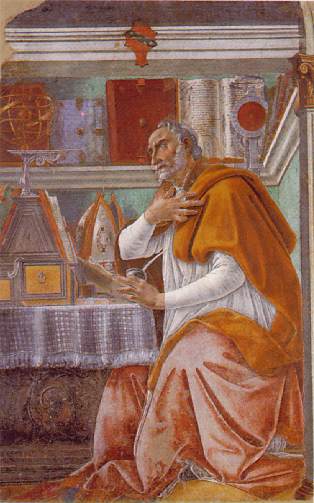
(Image: St. Augustine as painted by Botticelli in 1480, here.)

A Conversation: Into the Silent Land


Some weeks ago, Michelle of Quantum Theology and I discovered that we had both been reading the same book, Into the Silent Land: A Guide to the Christian Practice of Contemplation by Martin Laird, O.S.A.  It wasn't too long before we decided to try out a series of guest posts about our reading at one another's blogs.

Michelle and I "met" through some combination, now blurred in memory (mine at least) of our mutual RevGals participation, experiences of family loss, and love for Ignatian spirituality.  I'm not sure exactly how this will turn out, but I hope you'll all enjoy the effort.  Michelle is a Catholic who's also involved in Augustinian community life (which I'm hoping she'll explain), a chemistry professor who writes a column on prayer for her local Catholic paper, and a wife and mom of teenage boys who teaches contemplative classroom practice.

We're also hoping that our author, a professor of religious studies and philosophy at Villanova University, will put in an appearance.  What fun! ~ to explore a writer's work through conversation with a good friend, and then to hear his response to ours!

Welcome, Michelle!

P.S. Jan over at Yearning for God is also reading and blogging about this book!