Showing posts with label Mary Oliver. Show all posts

Wednesday, July 9, 2014

Rediscovering Wonder

When I was a little girl growing up in the country, wonder was an everyday experience. The caterpillars we watched morph into butterflies, the birds we spent days trying to catch, the creek we wandered for hours, the snakes we actually did catch and keep in jars on the stone wall out back until we tired of them and let them go.

Today they say that children experience grief in spurts, moving quickly back and forth between moments of intense sadness and periods of play and humor.  That rings true to me, and it also explains why otherwise intelligent and perceptive adults fifty years ago believed the professionals who told them that children do not grieve.  Those moments of intensity come on quickly for children, and disappear almost as fast, rendering them invisible to people who don't want to see them anyway.  And children are quick to sense the latter, and learn to keep their sorrows to themselves.

Thus I could roam the countryside, play sixteen-inning games of softball, and splash in summer camp brooks and waterfalls, finding wonder easily despite the airless density of childhood loss.

For adults, it's somewhat different.

A couple of summers ago, I heard myself saying to a spiritual director, "I was, quite simply . . . completely enchanted by my children.  And then . . . one of them was gone.  And thus enchantment evaporated from my life."

I've been reflecting on that statement this summer.  Perhaps my capacity for wonder, if not actual enchantment, is making a comeback.  Or, at least, tapping on the door.  This summer has already ushered in its grueling moments, with more predicted ~ most of them having to do with pretending to enjoy myself so that others are not burdened.  But I find that I am longing for some genuine joy.

Interesting, isn't it, that this surge of hopeful anticipation should accompany my renewed ability to walk short distances?  Yesterday I walked a mile around my immediate neighborhood early in the morning, and another mile in the opposite direction in the evening.  It's such a pleasure to see the world on foot again, to notice faces and dogs and gardens in ways that one can't from a car.
 
In her poem When Death Comes, Mary Oliver, who has certainly experienced her own deep loss, says:
 
When it’s over, I want to say: all my life
I was a bride married to amazement.
I was the bridegroom, taking the world into my arms.
 
Regretfully, I will not be able to say that of all my life.   Or, perhaps, I will.  Perhaps the black hole of the last six years, sucking all the gravity into a huge and heavy space of darkness, will someday reveal itself as its own venue of wonder.
 
But for now, I think I would like to return to the more conventional forms.


Saturday, July 20, 2013

6-12/60


Horses in the pasture at camp ~ looks the same 50 years later.


Nine days till 60!  Looking back at ages 6-12:

The basics:  Stark realities:  My mother and baby brother were killed in a car accident when I was seven and my surviving brother was four; the two of us were badly injured.   Two and one-half years later we acquired our first step-mother, who brought two of her children from Florida and left two there with their father. (When I speak of my brothers, I mean the stepbrother who was my age, my biological brother 2.5 years younger, and the stepbrother 2.5 years younger than my own brother.) 

One word:  Bewildered.
 
Best memories:  Gwynn Valley Camp in NC, where I spent the summers I turned ten and eleven.  (All of my children would eventually become campers there, and two of them staffers.)  It was a long 500 miles from home and in those days, camp sessions were four and eight weeks long.  It separated me from my stepmother, gave me back some childhood and some sense of accomplishment, and saved my life in many ways.  Other best memories:  The trips my grandmother and I made to Williamsburg and out west: Salt Lake, Yellowstone, the Tetons.  The beginnings of my passion for travel.  And the monarch butterflies my grandmother "raised" on her back porch.
 
Biggest fears:  Other than the deep end of the pool, a fear which I conquered when I finally learned to swim at camp, I don't recall being afraid of much.  (My brothers and I really did spend long hours in fields and creeks hunting down innocent snakes, some of which we killed and some of which we saved for awhile in jars before letting them go.  And we spent a lot of time high in trees and riding our bikes a considerable distance from home.)  As I look back on those years, I realize that I was a little survivor.  It's a trait that would serve me well fifty years later.  I've never lost the sense that the universe is as treacherous and chaotic a place as it is mystifyingly lovely,  and that survival skills are good ones to keep handy.  I learned most of mine when I was seven and eight and nine.
 
Best book:  TKM, which I read for the first time under the covers with a flashlight in fifth grade.  Although our ages differed, the three of us older kids were remarkably like Scout, Jem, and Dill, and my father remarkably like Atticus.  
 
Music:  The Beatles, the beginning of the major soundtrack of  my life.
 
Quote:  Mary Oliver's entire "Love Sorrow" poem from her book Red Bird. This has become one of my favorites in the past few years, but I see now that it serves as a narrative for my childhood.


Love sorrow. She is yours now, and you must
take care of what has been
given. Brush her hair, help her
into her little coat, hold her hand,
especially when crossing a street. For, think,

what if you should lose her? Then you would be
sorrow yourself; her drawn face, her sleeplessness
would be yours. Take care, touch
her forehead that she feel herself not so

utterly alone. And smile, that she does not
altogether forget the world before the lesson.
Have patience in abundance. And do not
ever lie or ever leave her even for a moment

by herself, which is to say, possibly, again,
abandoned. She is strange, mute, difficult,
sometimes unmanageable but, remember, she is a child.
And amazing things can happen. And you may see,

as the two of you go
walking together in the morning light, how
little by little she relaxes; she looks about her;
she begins to grow.


Monday, July 8, 2013

Noticing


Nearly everything I've read so far this morning has been about Noticing.  I'm going to take that as a hint.


From the Pope
 
 
All of which reminded me of Mary Oliver's poem, "I happened to be standing."


Saturday, June 8, 2013

Newbies


The ostensible subject matter of this particular Mary Oliver poem is crickets, but I think it applies to my house finches as well:


Let us hope


It will always be like this,
each of us going on
in our inexplicable ways
building the universe.


from
 
Why I Wake Early (2004)


Friday, October 19, 2012

Mary Oliver: A Thousand Mornings


I am reading as I write, so this isn't so much a book review as an expression of joy in the publication of a new volume of poetry by Mary Oliver.

If I recall correctly, my first introduction to Mary Oliver came courtesy of my daughter's 11th grade English teacher, who used her allotted 20 minutes or so on Parents' Night to teach us (the parents) a brief lesson on "Praying" in order to demonstrate what she was doing with our young people.   ("It doesn't have to be the blue iris . . . ".)

That would have been in the fall of 2003.  Since then, Mary Oliver's poems have had a way of popping up in ways that, could I list them all, would probably form themselves into an outline of many of the most significant people in my life.

Which poem do I love the most?  I don't know.  These are the lines I tend to quote:

You do not have to be good.
You do not have to walk on your knees
For a hundred miles through the desert, repenting.


(from "Wild Geese") 


She is strange, mute, difficult,
sometimes unmanageable but, remember, she is a child,
And amazing things can happen.

(from "Love Sorrow")

How I linger
to admire, admire, admire
the things of this world
that are kind, and maybe

also troubled -

roses in the wind,
the sea geese on the steep waves,
a love
to which there is no reply?

(from "Heavy") 


And now, in a new gift:

But I thought, of the wren's singing, what could this be if it isn't a prayer? 

(from "I Happened To Be Standing")


This last reminded me of my grandmother, whose clothespin bag, hanging on the line, was rendered useless on more than one occasion by nesting wrens.

Mary Oliver, of course, would remind us to question our definitions of usefulness and uselessness.  What could possibly be more useful than wren parents who have set up housekeeping in a clothespin bag? 

As we stood beside my grandmother's grave a few winters ago, listening to my daughter sing, a Carolina wren blended his voice with hers.  What else could it be, but a prayer?


Wednesday, August 29, 2012

Late August: Morning Walk


 I love this path, and almost always see deer here.  But this morning there was a dog off leash, running around and barking, with an owner telling me,"Oh, he's fine."  So much for the deer.


Very peaceful this morning.  Not sure how the algae appeared so fast.


I never tire of this view as it changes through the seasons. I am so grateful to the 1960s little old ladies wearing sneakers and carrying binoculars who turned out to be savvy and determined activists.  They saved this spot for the birds and for the rest of us from the folks whose highest and best ambitions involved an interstate highway.  I mean, seriously: Do you look at this and think, "Yay!  Interstate!" ???


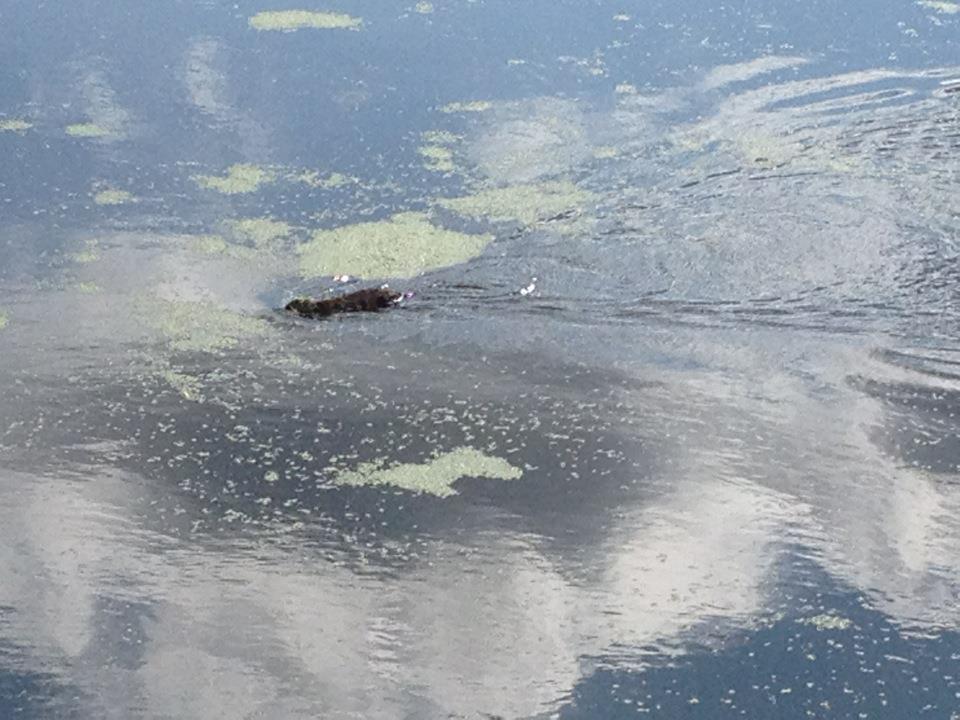
A muskrat appeared!  He swam practically under my feet a minute after this, but I couldn't get my phone to re-load, so this photo was the best I could do.

*****


I wonder whether I'll ever figure out what to do with this week.  I guess one simply lives it, all of it.

Late August.  I'm off for two weeks because of just how difficult it is. I've planned out all my sermons -- texts, topics, and even most of the titles -- through November, and begun to think through how I might want to approach Advent.   I'm realizing with considerable satisfaction that next month I won't be "the pastor we just called who was diagnosed with breast cancer at the same time," and in December I won't be "the new pastor."  I'll be "our pastor."  

Pretty cool, I think.

Meanwhile, my next project involves excavating an attic -- because, you know, I have a sermon to write.  As well as another piece of writing to ponder.  

But I'm remembering a lot as well.

August, 1984 -- a beautiful month, like this one.  I remember surfacing from the city pool like a baby whale, and the furtive glances of teen-aged boys as I climbed out via the ladder, swimsuit plastered to the belly that contained thirteen-plus pounds of babies. I chuckled to myself, thinking that I was doing more to promote the careful use of birth control than any lecture at the local high school might have achieved.

This year, since it's twenty-eight years later, presents the new challenge of the days and dates matching up.  Thursday, today: blissful unawareness.  Friday: Panicked doctors, no longer able to tolerate the presence of a woman more than forty weeks pregnant with twins, and a resultant decision to induce labor.  Saturday:  Happy Birthday, Josh and Matt! - whom I first saw in the mirror during the c-section.  (Yeah, that induction thing . . . kind of a disaster.  As well as  the attempts at alleged anesthesia.)

I'm (obviously) going through a lot of photo albums and transferring pictures to CDs. Some of them are showing up here and on Facebook.  I can't do the ones from the 80s yet, but I'm having a lot of fun remembering subsequent years.

A week of mixed feelings.  As I walked around the lake this morning, I prayed Mary Oliver's Wild Geese.  The geese won't be flying overhead for a few more weeks (though grebes have started to come through) , but the rest of the poem applies.


. . .
Tell me about despair, yours, and I will tell you mine.
Meanwhile the world goes on.
Meanwhile the sun and the clear pebbles of the rain
are moving across the landscapes,
. . .
Meanwhile the wild geese, high in the clean blue air,
are heading home again.
Whoever you are, no matter how lonely,
the world offers itself to your imagination,
calls to you like the wild geese, harsh and exciting --
over and over announcing your place
in the family of things.

Wednesday, November 3, 2010

Friendship with God

Sixty! ~ that was the birthday celebrated several days ago by a blogger whom I read regularly. Her birthday celebration was quite simply wonderful ~ she was surrounded by all of her children, including a couple of them who had traveled quite a distance to surprise her.  She remarked upon how her life has gotten better with each decade and how she anticipates the same continuing.  A wonderfully generous and expectant attitude in our youth-driven culture, a culture in which people bemoan turning thirty as if that's one of life's worst curses.

Her experience will not be mine.  I was startled to realize that for me the thirties, two decades past, will always be my best one.  My late forties brought some sad and difficult challenges and my fifties, begun in such joy and anticipation, have brought with them one of life's greatest sorrows.  I can, and do, look forward to many things in work and in love, including most especially the possibility of my surviving children's marriages and their own children, all of which, should any of it occur, will bring me tremendous joy.  But there will always, always be the reality that Josh is not here to share it, or to add his own wife and children to the mix.  The girl he was hoping to marry is beautiful and brilliant and gifted and sensitive, and the loss of her as the daughter-in-law of whom I had dreamed is another facet of this endlessly turning prism of sadness.

And so I was greatly pained, in an envious and angry kind of way, to read of my friend's happiness on her birthday.  (Charming, yes?  Envy is such an attractive personality trait.) And then I thought, as I have begun to on occasion (RARE occasion), that perhaps my experience harbors another kind of blessing.  The invitation to accompany Jesus into this kind of wilderness is an offer of tremendous friendship, in the sense that we long for our friends to share and understand our experiences.  And when I think about it ~ with whom do we share our most searing pain and our longing for wholeness?  Very few people.  I know that as a spiritual director I am often awed by what people entrust to me, knowing that it is a great privilege to receive some of their hardest and saddest experiences ~ because I myself offer mine to only a very few and deeply trusted individuals. 

Flannery O'Connor says that the Christian life involves taking up one's cross everyday.  Well.  Here we are.  I cannot think of a single more unlikely or ambivalent candidate than myself. The idea of embracing suffering has no appeal for me, none whatever.  I have no interest in being brave or strong or an inspiration to anyone.  I am pretty sure that most anyone who reads this will be fairly convinced that I have lost my mind or gone over to the far side of religious extremism, but let me assure you:  I would be quite willing to embrace a perfectly ordinary suburban life, all sparkly with grandchildren and puppies.  I have never, thanks to my childhood, taken for granted the grace of ordinary hopes and expectations fulfilled in ordinary ways. 

But ~ it's gone, that ordinary life ~ at least the wholeness of it is. And with it, any chance of my engaging in a relationship with God without being profoundly drawn into the matter of human suffering and ultimate hope for release and healing.  No ~ I go there and I want to know what that cross is about and what that bread and cup are about.  I want to know what is shared with us and what is healed, restored, recreated.  I want to know what God's friendship really means, what it means on God's side and what it means on ours.

And so I wonder these days about another of Mary Oliver's poems, the one ~ I think it's called "The Uses of Sorrow"  ~  in which she says,

"Someone I loved once gave me a box of darkness.
It took me years to understand that this, too, was a gift."

Perhaps someday I can report back on what the exact number of those years is.

Monday, October 25, 2010

Growing Into It

It goes on  endlessly, this bereavement business, but it changes.  You just keep moving around the contents of your backpack, looking for different ways to balance the weight.  Yesterday in church, a conversation with three other mothers in a room vacated by the rest of our class: we are all doing all of it simultaneously, grieving for children gone for 12, 8, 4, and 2 years, and living the other parts of our lives. 

This poem ~ never discussed, but a big part of my retreat:

Love Sorrow ~ by Mary Oliver

Love sorrow. She is yours now, and you must
take care of what has been
given. Brush her hair, help her
into her little coat, hold her hand, 
especially when crossing a street. For, think,

what if you should lose her? Then you would be
sorrow yourself; her drawn face, her sleeplessness
would be yours. Take care, touch
her forehead that she feel herself not so

utterly alone. And smile, that she does not
altogether forget the world before the lesson.
Have patience in abundance. And do not
ever lie or ever leave her even for a moment

by herself, which is to say, possibly, again,
abandoned. She is strange, mute, difficult,
sometimes unmanageable but, remember, she is a child. 
And amazing things can happen. And you may see, 

as the two of you go
walking together in the morning light, how
little by little she relaxes; she looks about her;
she begins to grow.


Saturday, May 8, 2010

Mother's Day


Heavy

~ by Mary Oliver

That time
I thought I could not
go any closer to grief
without dying

I went closer,
and I did not die.
Surely God
had His hand in this,

as well as friends.
Still, I was bent,
and my laughter,
as the poet said,

was nowhere to be found.
Then said my friend Daniel
(brave even among the lions),
"It's not the weight you carry

but how you carry it --
books, bricks, grief --
it's all in the way
you embrace it, balance it, carry it

when you cannot, and would not,
put it down."
So I went practicing.
Have you noticed?

Have you heard
the laughter
that comes, now and again,
out of my startled mouth?

How I linger
to admire, admire, admire
the things of this world
that are kind, and maybe

also troubled --
roses in the wind,
the sea geese on the steep waves,
a love to which there is no reply?


(Imagde here: Geese over Galway Bay by Monasette.)

Friday, April 30, 2010

The Spiritual Practice of Household Composition - 1


Just for fun: Jot down five places you've lived in your life. Anyplace, including a dorm room, counts. Do it quickly. Now write down your favorite thing about each place. See any commonalities? Any reflections in what they mean?

Observation: I did this the other night and included my childhood home, a college dorm room, and three apartments. What jumped out? That my favorite thing about four of the five was windows: big, wall-spanning windows. Some looked out onto hills and woods and water, and some onto city streets, but all of them were big and let sunlight pour into the indoors.

Reality: I have never paid the slightest attention to "window treatments." Actually, we have almost none. When we moved into this house, we had curtain panels on rods that covered the bottom halves of most of the windows, courtesy of the prior owners. Three children in three years ~ meaning that at one point their ages were five, five, and two ~ meant that said rods and curtains were quickly dismantled. And never replaced with anything. Some of the bedrooms have curtains, but not all.


Reflection: There are big windows across the front of our house, which faces sort of north. The best light in the house is the mellow yellow afternoon light that streams into the living and dining rooms from those windows. But there are big double-hung windows, lots of them, on all sides of the house. The views aren't much, but the light is wonderful.


The spiritual part: The windows and the light they offer are much more significant than I've been conscious of. What can I do, I wonder, to enhance and draw attention to the windows themselves, and to take better advantage of the light in terms of displaying artwork around the house? What might draw the windows and the light into the design of our interiors, so that the windows become integral aspects of the rooms rather then mere slots through which light is transferred?


*********


Why I Wake Early

by Mary Oliver


Hello, sun in my face.

Hello, you who made the morning

and spread it over the fields

and into the faces of the tulips
\and the nodding morning glories,

and into the windows of, even,
the
miserable and the crotchety
best preacher that ever was,
dear star, that just happens to be
where you are in the universe

to keep us from ever-darkness,

to ease us with warm touching,

to hold us in the great hands of light
good morning, good morning, good morning.
Watch, now, how I start the day

in happiness, in kindness.


**********


That is not why I wake early. I wake early because I can't sleep more than a few hours at a stretch. But when I wake up, there is light. Or there will be, in another hour or two. And so: windows. I want to become aware of windows.