Showing posts with label Catholic. Show all posts

Monday, September 21, 2015

Life with Nuns


My friends are sometimes startled to learn that I spent three years in a Catholic school.  A Catholic girls' school.  A Catholic girls' boarding school.
 
I was only twelve when I was deposited with the nuns, in a pre-Vatican II environment of fully habited nuns, Latin masses, saints' days, required daily religion classes, and words like refectory and collation.


It's a long story, one which I won't relate here.  But it might reflect a thread of grace, one that began to unwind in the 1890s when my very Methodist great-grandmother drove her buggy ten miles through the country to the convent for piano lessons, and was most recently in evidence when I went to our reunion last Saturday.
 
As I visited with the hundred or some women there for lunch, reports, hugs, and laughter, I mused on the experiences we had shared, so different from those of most of our contemporaries.  
 
The navy blue skirts, white blouses, and saddle shoes.  The little alcoves, beds and side tables lining the length of long, third-floor dormitories and separated from one another by white curtains.  The midnight conversations as we curled up in our nightgowns in wide window wells overlooking well-maintained grounds. 
 
The many efforts we made to break into the off-limits cloistered hallways secreted behind closed, unmarked doors. The evening study groups, radios blaring and books strewn across desks as we tried to unravel the mysteries of algebra and dreamed of encounters with Paul McCartney. The Saturday afternoon sewing classes, from which some of us routinely escaped to undisclosed locations. 
 
The alternating mystery and boredom of the Latin mass.  The glowing woodwork and high windows and ceilings we took for granted.  The very, very distinct personalities of the nuns, brilliant and highly educated women who presumed that we would, too, would grow into forces to be reckoned with. 
 
Thanks to modern technology, we are all re-connected,  30 and 40 and 50 years after we shared convent school life.  A couple of the nuns attended my ordination four years ago.  They really love us.  We really love them. 
 
Real, true, amazing, grace.


Saturday, December 28, 2013

Cool Ursuline Stuff

We've been down in southern Ohio visiting my family for a couple of days.  Since a Great Controversy erupted this past fall among the alums of my Catholic boarding school over a new project to eliminate a dam and reclaim a creek on the nuns' property, I thought I'd go over and photograph the project so that I could post pictures on FB.
 
While I was there, I took some other photos on the campus.  The one below is a rendition, made by  a sister/artist/friend, of Julia Chatfield's placing of a cross in the wilderness when she and ten other sisters arrived from France in 1845:


The campus is located about 30 miles north of Cincinnati.  Some history (underlining is mine), for anyone who's interested in women's education, Catholic education, Catholic sisters, and a host of others topics, from the website of Cincinnati's Ursuline Academy:

"[In] 1474 . . .  Angela Merici was born in Desenzano, a small town in northern Italy. Early in her life Angela had a direct indication from the Holy Spirit that she would found, in Brescia, a company of women consecrated to the Lord. Angela established the Ursulines in 1535. It was the first non-cloistered community of women in the history of the church, and the first religious community for women begun by a woman. Inspired by Gospel challenges, Angela and her followers reached out to rich and poor alike with special concern for the development of a strong family life. A true educator, Angela empowered people to reach their full potential and to use their skills in service.

From their foundation in Italy, Ursuline communities were established all over Europe. They came to the "New World" via Canada in 1639. Ursulines established the very first religious community of women in the United States in New Orleans in 1727.

The Ursulines of Brown County were founded by another woman of vision and faith, Julia Chatfield. As an Ursuline of Bologne-sur-mer, her pioneer spirit enticed her to accept the invitation of Bishop John Purcell to come to the newly formed Cincinnati diocese in 1845. The Ursulines of Bologne-sur-mer and Beaulieu joined forces and sent Julia Chatfield and ten other nuns to St. Martin where the diocese had built a seminary and established a parish. The seminary was being moved back to Cincinnati and the sisters were given 400 acres of land to be used for educational purposes.
 
Sister Julia Chatfield became Ohio’s “pioneer nun” whose determination to establish education in the wilderness endures after 165 years. She was inducted into the Ohio Women’s Hall of Fame on June 5, 2001 in recognition of the accomplishments she achieved:
  • In 1845 Sr. Julia answered a call to come to Ohio from France;
  • Sr. Julia founded the Ursulines of Brown County in Ohio, a congregation of women religious that endures today;
  • Sr. Julia established a resident school for young women incorporated in 1846 under the title St. Ursula Literary Institute. After 135 years, the school closed in 1981;
  • Sr. Julia instilled her determination to promote education into her successors; for example:
    • 1896 – establishment of Ursuline Academy of Cincinnati, a college preparatory school for young women;
    • 1940s – Ursuline Sisters’ participation in elementary and secondary education in the Archdiocese of Cincinnati and beyond, in higher education, and adult education;
    • 1971 – Chatfield College – St. Martin and Cincinnati campuses serving Appalachian and inner city populations.
Some of the most important things I know about how to be a person, I learned from Ursuline nuns.  From the cemetery, a plaque listing those who came from France: women of faith and courage and determination.


Sunday, July 21, 2013

12-18/60

Eight days to go . . .

The basics: These were the girls' boarding school years.  Grades 7-9 with the Ursuline nuns in Ohio and grades 10-12 at Northfield, one of the schools founded by evangelist D.L. Moody in Massachusetts.  No stereotyping allowed! Those were the places in which I gained a grounding in religion that was open-minded, progressive, and scholarly.  The Catholics were just blossoming forth from Vatican II and the Protestants were heavily influenced by Tillich and the social justice movement.  Once I got to Northfield, I seldom went home anymore; I spent my spring breaks in Florida with my grandparents and my summers doing a mother's helper gig for a family on Cape Cod.  Those were influential but impressively unproductive years; I was a terrible student and my extra-curricular activities were unbloggable.

Key phrase: "You are wasting your potential."

Best memories:  Oh, most of those are unbloggable, too.  But there was the music at Northfield, which had an incredible choral program.  Even those of us who otherwise did little more than tunelessly hum Beatles' and Joni Mitchell songs had to participate. 
 
Spring 1970 Sacred Concert, dedicated to Kent State.  Many of us would probably agree that singing the David Stanley York arrangement of "Once to Every Man and Nation" was one of the defining moments of our lives.  It's completely different from the jaunty version found in most hymnals and was powerfully appropriate to that period in our national history.

And, amazingly, I've finally found a recording online ~ from a Presbyterian church in Dayton, of all places.  You have to scroll about two-thirds of the way down the page to 9.5.10 and then click on the title.  I would suggest turning the volume way up and imagining the young voices of 1200 idealistic high school students accompanied by an orchestra on a sunny spring day in western Massachusetts at the height of the Vietnam War.

A little reflection: One of the things one asks at 60 is how on earth she got to be who and where she is.  I did not, at the age of sixteen that afternoon at Northfield, believe for one minute that there was a God standing within the shadow keeping watch above anyone at all. 
 
But everything was in place, wasn't it?  Immersion in the beauty of creation, from rural Ohio to the Atlantic coastline to the foothills of the Berkshires;  a family's terrible suffering; a demanding religious and musical education ~ and a relentlessly skeptical but still hopeful mind and heart. 
 
No WONDER.
 
One could possibly even believe that God engineered all of this.

Here are the James Russell Lowell lyrics as adapted if you want to listen and read what you're hearing:

Once to every man and nation, comes the moment to decide,
In the strife of truth with falsehood, for the good or evil side;

 
By the light of burning martyrs, Jesus' bleeding feet I track,
Toiling up new Calv’ries ever with the cross that turns not back;

 
Though the cause of evil prosper, yet 'tis truth alone is strong;
Truth forever on the scaffold, and forever on the throne;


Yet that scaffold sways the future, and behind the dim unknown,
Standeth God within the shadow, keeping watch above His own.


Friday, March 22, 2013

Boarding School Years ~ Catholic

Readers here know that I spent six years in girls' boarding schools: three Catholic and three Protestant.  A treasure trove of images of each has popped up on Facebook recently, and I thought I'd share.  The following come mostly from Pavey Photography; I don't know whether Ann Pavey attended the School of the Brown County Ursulines (now closed) as a girl or Chatfield College as an adult, but her photos reveal a genuine love of the campus.
 
My own family history as intertwined with the Ursulines, in a nutshell:
 
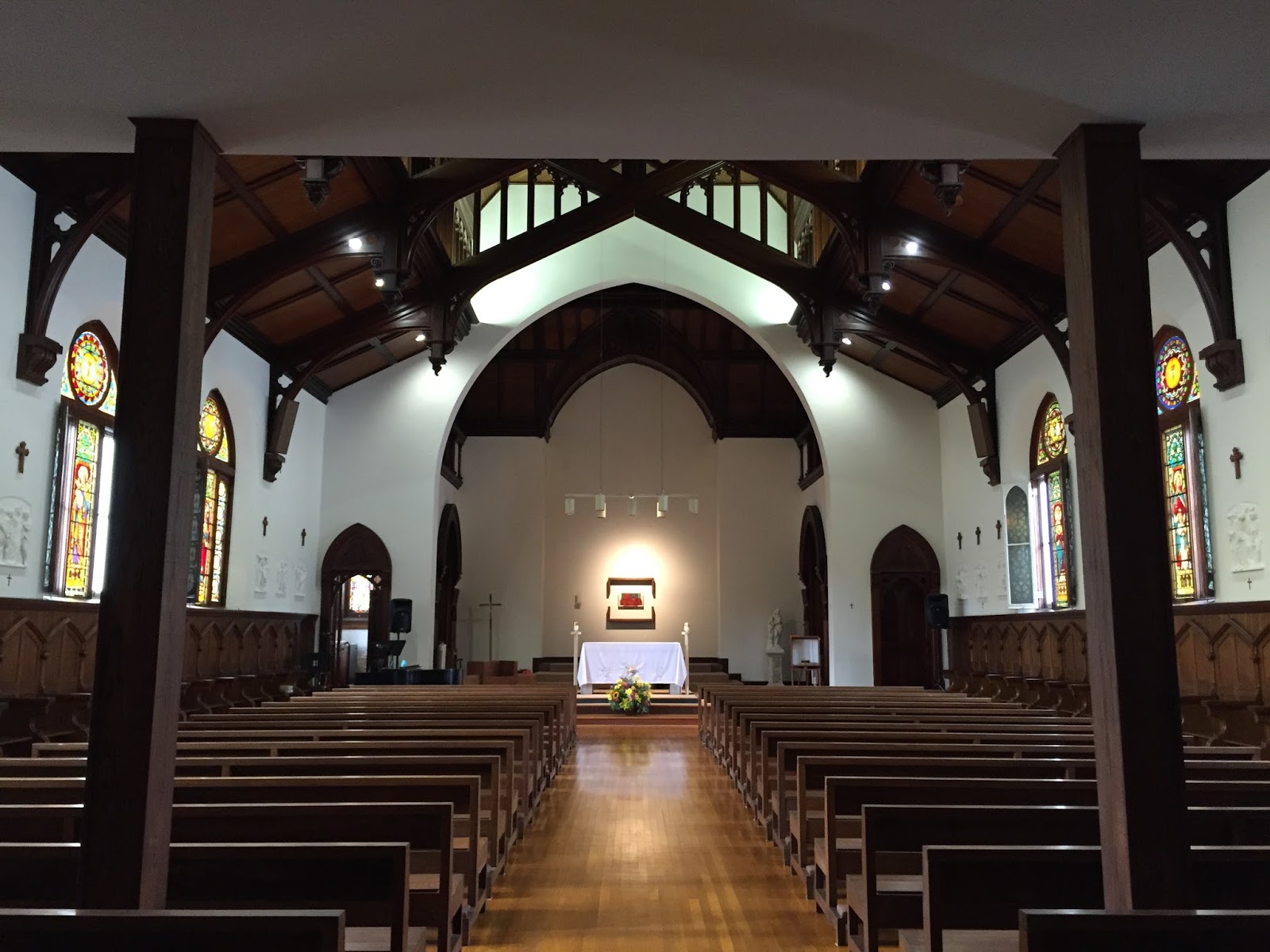
The Ursuline sisters ventured from France to southwestern Ohio in 1845 and opened a school for girls about thirty miles north of Cincinnati.   I'm not sure when this main chapel was built ~ maybe someone will add some information in the comments ~ but it was at one time attached to a massive convent building of red brick. 


The nuns hired a master carver to teach them to make the intricate carvings that adorned their small chapel in the main building ~ although I think this one is from what we knew as the main chapel:


In the late 1800s, my great-grandmother wanted to study piano and, so the story goes, sold her egg money to pay for lessons and drove her buggy the eight miles or so to the convent to study with the nuns.
 
In the early 1900s, she and my great-grandfather were married and he established what would become the family grain business, which eventually developed a relationship with the nuns, who ran a farm as well as a school.  I am sure that my grandfather and father, as well as my brother and I, would count the Ursuline sisters as among our dearest of friends.  I don't think I have a photo of those who came to my ordination service, but I do have one of Sister Agatha with my daughter, taken a couple of summers ago.


No daughters in the family until I came along, and off I went to the Ursulines' school when I was a seventh grader.  The chapel was a good deal more ornate pre-Vatican II, but it's still there.   My family was Methodist in a not-so-much kind of way, although I am told that that same piano-lesson great-grandmother as a grown woman used to sail down the street to the Methodist parsonage on Monday mornings to offer the pastor her views on the previous day's sermon.  (Is that where the genes come from?  I'm sure he was just delighted to see her making her way down the block . . .     . )  At any rate, I was not anything in particular, religion-wise.  But I did attend Mass and various other services here regularly for three years, which meant that when I bumped into the Jesuits decades later, I was comfortable with Catholicism.


My friends and I spent an awful lot of time climbing around and through various convent locales in which our presence was not exactly sought.  I think that Ann  Pavey has done an incredible job of capturing the sense of beauty and mystery of  the buildings which I'm sure that all the women who lived there as girls still think of as "ours."


The school is long gone now, and so is the building which housed it.  The nuns built themselves a smaller and more user-friendly home, and the small college on the grounds, established to educate young teaching sisters, is now a vital and thriving educational institution, open to all who live near this community on the edge of Appalachia. 
 
And, while I've posted this one before, I'll close with a photo of the plaque on the wall of one of the college buildings, which reflects a gift made by my father in memory of our Josh and a century-plus of wonderful friendship and love.


Wednesday, March 13, 2013

Pope SJ


Among those ironic twists of fate or unpredictable wanderings of the Holy Spirit, depending upon how you look at it, it's been one of the great privileges of my life during the last decade to have been influenced by and become friends with some Jesuits.  They have been extravagantly generous with their brilliance, their knowledge, their pastoral presence, and their encouragement. There is no question whatever that I would not be a pastor today, nor would I have survived (in the most literal sense of the word) my son's death without their Spiritual Exercises and their personal support, attentiveness, concern, and help during what I surely hope will turn out to have been the darkest period of my life.
 
The Jesuits with whom I correspond generally simply sign their names at the ends of their emails and notes, but one of them always signs his as "Bill SJ."  And I am always touched by that signature at the bottom of a page, as it bespeaks such a commitment to and identification with the 450-year-old Society of Jesus.
 
And so I feel an unexpected connection to this new pope.  I haven't paid much attention to what's been going on in Rome; most of my very brief updates have come from, ironically again, members of my first Presbyterian church, who are on a long-planned journey to Rome during this of all weeks.  But the news of a Jesuit pope -- yes, to that I'm attentive.
 
I'm still wondering whether the Francis refers to Assisi or Xavier -- one of my friends responded to that question on FB with the words "both/and."   !  (See my previous completely unrelated post.)  I don't have the impression that the newscasters have a clue, but they've heard more about the former saint than the latter.
 
At any rate, we are perhaps about to get a lesson on the complexities of faith and the hopelessness of labels with respect thereto.  The poor in Argentina?  The right-wing dictatorship?  Gay marriage?  The celibate priesthood?  The words are flying on the news.  And, finally, someone on CNN has just uttered the name "Francis Xavier."
 
I have hopes for this pope, and I had not expected that.  (The unexpected ~ a  sign of the Spirit laboring, yes?)  From what I know of the men formed by the Spiritual Exercises, we have every reason to expect a profound depth of intellect and an expansive pastoral capacity.  So, yes ~ high hopes.


Tuesday, October 23, 2012

Looking Back

A couple of weeks ago I was invited to emcee an event next April: the dinner celebration of the tenth anniversary year of the Ignatian Spirituality Institute, the program in which I studied spiritual direction. I started wondering what I had been up to during the April in which I was making the Exercises, and dug back through my journals to see whether I could uncover something that might help me introduce the event.  (I may have.)  

Then, as long as I had my file boxes of prayer reflection journals out (twenty-some over the past eight years!), I wondered what the October entries would show.  How life has changed  .  .  .   .

October 19, 2005

A few weeks into the Spiritual Exercises, which means that I have made a commitment to an hour or so of prayer time each day (I am nowhere close to meeting that commitment) and a weekly meeting with a spiritual director, who is very gentle and very funny, and takes my beginning efforts very seriously.  Recently returned from visiting Josh at The University of Chicago.  I am an elder in my home Presbyterian church and a teacher in an Orthdox Jewish school, and my life of prayer is in its infancy.

" 'Be still and know that I am God.'

Really, these are words that you could put into use anywhere, any day, in the middle of anything.  Staring with the 'be still.'  Meaning: Create an interior stillness.  Lose all the internal chatter.  That in itself would be a discipline.

Just right now: I can hear the tv in the living room, the dog walking around hopefully in the kitchen, the clatter of these [computer] keys.  But I can try to create an inner stillness.  A hollow place.  Not an empty place, but a warm, hollow, inviting place for God to rest.  How would I do that during the day?"

October 17, 2006

The Exercises are, officially, behind me, and have become the framework for my spiritual life.  I am embarking upon the ordination journey, and have just been endorsed by the Session of my home church as an Inquirer in the official process.  I'm visiting and applying to seminaries, and there's no reason to think that all will not go splendidly.

In my journal: A brief email exchange with my spiritual director on the continual dilemma in my life: Protestant/Catholic; Ignatius/Calvin (both studying in Paris in the 1530s, where I spent time in July imagining them both).  He has some reading suggestions. 

October 20, 2007

I am a brand-new new seminary student, reflecting on the Eucharist, which had been transformed for me the previous year from a boring ritual to a deeply significant sacrament, thanks to a Seder dinner at the home of one of my students, a meal shared in the context of Week 3 of the Exercises with its many imaginative prayers based on Jesus' final days.

"The seminary feels physically bereft to me.  No labyrinth.  No stained glass.  No statues.  No art. Puritan starkness in the extreme  It has its own beauty but it seems, as a day-after-day-after-day experience, on the empty side.  I begin to see how much I depend upon material, substantial reference points for faith."

Mid October, 2008

The entries are not dated, but they are stacked in order in a folder.  Josh has been gone for seven weeks.  My father thinks his cancer had recurred.  (It had not.) Spiritual director emeritus does have cancer.  ( From which he eventually recovered.) How much? I wondered, sitting in my living room late in the afternoon, hair dripping from the shower, looking in despair at the emails on my laptop. 

"What does it mean that people keep speaking and writing to me in this way -- you teach us so much, you will have more wisdom and compassion for others?  Does it mean that even in the midst of such a horrific loss, I am still called to serve?  Even though I am now a person who can barely get out of bed in the morning?  A person who could not be trusted with the life of her own child?"

October 19, 2009

I am back in seminary.  I am taking Worship and Sacraments and Hebrew Exegesis and something else (I have no idea what that might have been).  This is the fall that I spend almost entirely on Psalm 88, which probably helps to save my life.  

In my journal: A long email received this day from SDE, which I carried around, crumpled up in my pocket, for months, because I needed to read and re-read what was, in effect, an extended meditation on the Suscipe,  a prayer at the end of the Spiritual Exercises.  He writes, among other things, about coming to an acceptance of the mystery of faith.   I will get no answers, he tells me.  It is oddly reassuring, to be offered companionship in the articulation of that hard reality. 


Not a bad re-read this week, as I am contending with Job in the pulpit.  Odd, to look back at these entries from this vantage point.  What a terrible and strange and wonderful journey this has become.


Wednesday, September 19, 2012

Convent Boarding School Girl


The Ursuline sisters showed up in southwestern Ohio in 1845 and began to teach and to construct a massive building for their convent and boarding school. 

My own Methodist family's connection with them  began with my great-grandmother's desire for piano lessons when she was a young girl in the 1890s.  It was her husband who started the business that would become one of our small town's four grain dealers, and it was through business transactions with the sisters and their farm that our connections were solidified.

I spent my seventh-ninth grade years as a boarding student at the school.

In my family's history, those three years were fairly insignificant; other relationships expanded and continued far beyond my time and role as a schoolgirl. My grandparents and my father developed fast friendships with the sisters, solidified by their mutual interests in nature, education, and the arts.  When the small college one of the sisters had founded for the education of new sisters opened to the public, my father became a board member.  When my grandfather died, two of the sisters conducted his funeral service in his living room; when my grandmother died twenty years later, one of them led the service in which I participated in their small chapel.

In the history of the Catholic Church, my three years there represented not even a fraction of a drop in a bucket.  The changes wrought by Vatican II were sweeping the church.  Mass became somewhat intelligible to me as the language was switched from Latin to English, and the younger sisters either vanished altogether from convent life or began to dress like the rest of us. Forty-plus years later, I think that perhaps the latter was the greater change.  The drama was not that many women left, realizing that at 17 and 18 they had made promises they no longer wanted to keep in the face of a world opening to other opportunities.  The drama was that so many stayed, discovering ways of sustaining complete and lifelong commitments to God in a contemporary world no long bound by the exterior trappings of the late Middle Ages.

In my personal history, those three years left an indelible mark.  I've written about it here, so I won't belabor the point, other than to say that the last time I was with Ursulines in person was on October 30, when two of them made the eight-hour round trip to attend my ordination service.  In many ways, the wheels for that service started to turn all those decades ago when I was a twelve-year-old in a navy blue skirt and white blouse surrounded by women who turned their humor and intelligence and wisdom and energy into service to God all day, every day.

I missed this past Saturday's school reunion, but the Facebook pictures have popped up, including this one of a magnificent quilt made by I know not whom.  It's a wonderful reminder of the dedication of generations of gifted women in a small corner of Ohio.

Monday, August 13, 2012

LCWR


I don't usually do anything like this, but today I did ~ I started a FB group as a statement of support.  Please join, if you're qualified and so inclined:

Wednesday, May 30, 2012

Musings on Ministry

This morning The Questing Parson writes about an encounter with a young almost-pastor and his counsel to her with respect to her first assignment, for which she has grand hopes of growth in numbers.  “Slow the decline and then work on increasing the membership.”

Last Sunday, as occasionally happens, a visitor new to our church made a complimentary remark as to the accuracy of what she had heard about me.  As I thanked her, I looked around wondering, "So where is everyone?"  Word of mouth has not translated into numbers.  Not, I realize, that the numbers are about me.  And I'm trying to focus on depth rather than breadth, something which has been noticed (without prodding from me) by our leadership ~ but, naturally, I am aware of the quantitative element.

Meanwhile, my friend Michelle, who is chemistry professor and contemplative, and a published writer on both, is developing a writer's website.  I've just posted a comment on her FB page, stating that "I love the juxtaposition of the worn and battered composition books with the technology of the site -- reflective of your unique personal blend of contemplative and chemist. It evokes both Marie Curie and Thomas Merton gone contemporary in venue. (And you may recall that my 11th grade writing teacher instructed us that we were forbidden to use the word "unique" unless it applied, which situation was highly unlikely to occur. Here, finally, it does.)"

And now I ponder the connection, a matter which I've begun to process only recently.

Back in my Methodist (Questing Parson's milieu) days, I was a young attorney, struggling to make sense of the demands of my profession  in the context of a new and wobbly Christian faith.   In retrospect, it's clear that I had embarked, determinedly but without guidance, on a path toward a contemplative orientation.  Even when I asked as directly as I could (and I hasten to clarify that I did not know how to articulate the questions I had  or what it was that I was seeking), no assistance was forthcoming from pastors or congregational leaders.

I find myself wondering more and more frequently whether, if someone had been able to point the way, I would still be both a Methodist and a practicing attorney.  If I had been able to integrate both dimensions of my life, would I now be sharing my legal expertise as a leader in the United Methodist Church,  as does a Presbyterian friend with great generosity and care, and offering retreats and spiritual direction to my professional colleagues, as does a Catholic lawyer I know?

And what, exactly, is the connection between depth versus breadth and offering a doorway into the contemplative life in the context of the everyday?  I know; it seems obvious.  But in practice, a good deal more difficult than it looks.

I have been ordained exactly seven months today.  I suppose I am not required to have it all figured out yet.

Thursday, April 26, 2012

My Sisters

A bit of background: While I was on retreat last week, immersed in silence, the world lumbered on, and numerous concerns on which others were focused made their way into our masses in the form of prayer requests.  One day early in the week, the presider offered prayers for the LCWR in the face of the CDF's newly released critique, and expressed his solidarity with the sisters.  Huh?

Clarification came when the next day's presider explained the the Vatican's Congregation for the Doctrine of Faith (known in earlier centuries as the Inquisition) had issued a report criticizing the Leadership Conference of Women Religious for its over-attentiveness to issues of poverty and social justice and for its failure to focus on the Vatican's priorities in the areas of right-to-life and human family and sexuality issues. The CDF has established a panel of men (?) to oversee the sisters' organization for the next five years. 

There has been extensive coverage of this issue online, some of which raises serious questions about the integrity and competence of the oversight panel.  If you are interested, all you have to do is google "American Catholic sisters."  For today, my focus is on a twitter campaign launched by James Martin, S.J. , "What Sisters Mean to me," which I read about over at my friend Fran's place.  Twitter is not a part of my own communications arsenal, so I'll proceed with a blog post, per usual, and offer some observations about the profoundly Christlike presence of the women religious I know best, the Ursuline Sisters of Brown County, Ohio:

1.  They traveled from France in 1845 to  what was then the wilderness and is now the edge of Appalachia in southwestern Ohio,  and quickly established a school for girls, where I received my 7th-9th grade education 120 years later.

2.  They have been teachers, counselors, partners, ministers, supporters, encouragers, consolers, and I'm sure many other things I don't know about to countless of the people among whom they live, including my own family, for 167 years.

3.  Ursuline sisters taught my great-grandmother to play the piano in the 1890s, conducted or participated in the funerals of my grandfather (in his living room), my grandmother (in their chapel), and my stepmother (in a funeral home).

4.  A few decades ago, having concluded that their massive 19th century convent and school building was exhausting funds that could be better used elsewhere, the Ursulines engaged in one of the few great and unheralded acts of prophetic vision and courage which I've been privileged to witness.  They knocked that beautiful, energy-guzzling edifice down, moved to more modest and efficient quarters, and focused on ministry to people rather than to buildings.

5.  Today, the college that one of the sisters launched in the 1960s so that young nuns did not have to postpone their educations during the early years of their religious lives, years in which they were not at that time permitted to attend local universities, serves the entire region. It provides a warm and friendly setting in which farmers, laid-off workers, homemakers, high-school dropouts, and many others who would never otherwise have been able to imagine the possibility of college are able to earn degrees and embark upon new lives.

6.  While they are busy changing the world through education and attentiveness to those pesky issues of poverty and justice, the sisters are also present to the small but critical moments in the lives of those they care for.  Ursuline sisters have made the ten-hour round trip between their house and mine on several occasions: to bring my grandmother to see her brand-new great-granddaughter, to mourn our son with us, to celebrate an ordination with us.

I could go on, but I'm sure you get the picture. Let me just add the following:

New friends sometimes express astonishment that my then little agnostic-Methodist self spent three years in a Catholic girls' boarding school.  Their general sentiments might be summarized as, "Didn't that ruin you?"

Well, yes: I did spend those formative years there, in a community of women who ran a convent, a school, and a farm.  Women who throw their entire lives of prayer, education, expertise,  presence, intelligence, and humor into the world in service to others.  Women whose every move offers an example of how to live with grace and goodness.  

I guess they did kind of ruin me.  They ruined any capacity I might have had to accept the status quo, to follow conventional rules for women, to ignore the needs of the impoverished and uneducated.  They ruined any possibility that I might have failed to realize that an 80-year-old woman might launch a new community ministry, or that a teacher of Italian and music might bring communion to the dying, or that ecumenical friendship is a priority of the highest order.

Now, what is it exactly that the Vatican does not see?


Tuesday, April 10, 2012

Protestant + Steadfast + Sister

I almost titled this post  "Neither Non Nor Wayward ~ and not a Brother, Either" ~ but that would have meant toppling right into the trap laid for me.

Frequent readers of my blog know that I spend a considerable amount of time crossing worlds, especially Catholic and Protestant worlds.  I like it that way.  There's no question in my mind that I am called to the Christian faith, Protestant dimension, and that I am called to ordained ministry in that context, but I am most appreciative of the first 1500 years of Christianity and of the many gifts of contemporary Catholic faith, and also very much called to practice much of my faith life as taught and encouraged  by Ignatius of Loyola, a Catholic if ever there was one.  It's not always easy and I often bump up against difficult inconsistencies, but there's that whole "my ways are not your ways" thing, so I live with it.  Contentedly.

Some time ago it dawned on me (slowly, yes; I'm extremely slow about certain things) that Catholics and Protestants alike often refer to Protestants as "nonCatholics."  As soon as I realized it, I stopped doing it.  Why would I want to self-identify, or identify others, as something I or they are not?  It seems to me that the preface "non" implies a certain degree of either diminishment or exclusion with respect to the noun in question.  

(Interestingly, in my days as a teacher in an Orthodox Jewish day school, I was most often identified as a "Christian."  Clearly I was not of the majority there, but in general Jews seem content to identify others as who we are.  They don't resort to the term "nonJews.")

A few days ago, there was a debate over at The Deacon's Bench over whether or not Catholic priests should bless children during the Eucharist.  It seems that there are a great many rules and opinions about blessings and about children of which I was unaware but hey, this is their argument, not mine.  I still don't know much about it, having just stopped by on a friend's recommendation (?) this morning and skimmed the post ~ and the 150+ comments!

But there it was, that term "nonCatholic."  Suddenly I felt . . .  hmmm . . .  extremely irritated.    Moreso when I read another comment to the effect that many Protestant churches do not welcome children.  Excuse me?

And then, the grand piece de resistance: the referral to "wayward brethren."

OK, really? 

I am Protestant.  I am steadfast in my faith,  which has not been a matter of smooth sailing for me.  And I am female.  I am delighted to be all of those things.  

So, please.  Do not refer to me as one of your nonCatholic wayward brethren.  (I don't think I've ever done the reverse, by the way.  Some real bloopers have come out of my mouth, but "nonProtestant wayward brethren" is not one of them.  John Calvin et al. said some bad, bad stuff about the Catholic Church, but we are, thankfully, no longer in the 16th century.)

Protestant.  Steadfast, focused, and on track.  Female.

Please use correct terminology.

That's all I ask.

Thursday, March 22, 2012

Churches en Route


These are the churches that I pass en route to and from the Little Lakes:

Presbyterian


Episcopalian


Catholic


Thursday, March 1, 2012

Daily Photo - 31


My last post doesn't seem to have shown up anywhere so, since I'm home recuperating, I thought I'd do something I haven't done in awhile and post a daily photo.  Actually, I haven't been taking many photos lately.

My new call involves a lot of driving to towns and cities in east-central Ohio, as my congregants seem to have a tendency to land in various hospitals and nursing facilities scattered far and wide.  I've started to make sure that my camera is in the car, and one day last week that effort paid off.

The photo is of St. Peter's Catholic Church in Mansfield, Ohio. 

Monday, February 13, 2012

Calvin and Ignatius: The Lighter Side

I've long been intrigued by the simultaneous presence of John Calvin and Ignatius of Loyola in Paris during their student years.  Supposedly their portraits hang next to each other in what is now a government building.  We never managed to see them when we were there a few years go, but a friend and professor of mine attempted to do so last month.  It seems that the paintings have been moved and, according to her FB post, the response of a librarian to her request for information about their location side-by-side was as follows:

"Jamais, jamais ~ cote a cote dans l'eglise catholique ~ jamais!!" ~  with hands demonstrating an emphatic "Impossible!"


Monday, January 9, 2012

Where Do You Encounter God in Church?


Yes, I am genuinely interested in answers to this question.  (And don't worry - the next one will ask about outside of church.)  (And ~ perhaps this is a worry ~  I'm focused on churches here, and not on houses of worship across the board.)

I've spending a lot of time these days thinking and daydreaming and wondering about what church is.  There is, for example, church as my congregation remembers it: a 1950s full house, the multi-generational Sunday focus of everyone in town.  (It's a very small town.)  There's our church as it is right now: maybe one-third full on a Sunday, with most folks well over sixty.  There's our church as it might be ~ but I have no idea what that is.

For most of my congregants, the word church immediately conjures up a companion word: community.   And one of the things that I've been musing about is that, for me, it doesn't.  Not at first, anyway.

An odd acknowledgment for a pastor to make?  But I didn't grow up in a church community.  I found my way into the rich life of the church via theology, and architecture, and music, and communion, and a deep sense of mystery.  I eventually became part of a wonderfully energetic mainline church community, and then another, and now I lead a third, a group of loving, capable, and committed people who long for their church to blossom again.

But what will that entail, exactly?

Longtime readers may recall that after Josh died, I started attending church in a Catholic parish ~ where no one spoke to me, at all, ever.  It's a huge, vibrant parish, with lots going on, but I have no idea how one would become a participant.  I was looking for solitude, for God in music and ritual and prayer, and so the experience worked well for me, but had I been looking for God in community, I would have been lost.

And lest I be accused of singling out Catholics, let me add that when my husband and I, in our late twenties, first joined a large United Methodist church, it was at least a year before we had a conversation with anyone other than the senior pastor.  I had no idea what a church community was, so I was not dissatisifed but, looking back, I find it rather odd that no one at all approached us.  We were eager to become involved with the mission and justice activities of the church, but had no idea how to go about doing so.  And in the meantime, the ethereal music and the challenging preaching were enough.

At any rate, I'm wondering.  I think that if I were in a position to look for a new church for myself,  I would slip into a worship service and watch for mystery made manifest.  It would probably be some weeks before I paid attention to the bulletin and its lists of activities and groups.  But I have the feeling that I'm in a distinct minority.

What about you?  If you were to walk into a new church next Sunday, what would convince you that God was present there?


Image: Prince Edward Island, August 2005

Saturday, November 5, 2011

Breaking Bread with Online Friends


"How do you know all these people?" exclaimed a friend last night, when I stopped by her house to wish her a happy birthday.  "You had a rabbi from St. Louis and a photographer from Philadelphia at your ordination - how did that happen?"

A couple of years ago one of my seminary professors expressed great skepticism about internet interactions and friendships.

Let's see . . .

Carol isn't a rabbi, but she is a dear friend (unmet in real life until last Sunday!) as a consequence of fifteen years of emailing among a group of moms who met online.  Carol and I have enjoyed numerous discussions about Jewish-Christian matters over the years and she has been a rock in my life since Josh died.  Of course I wanted her to read Psalm 139, and to read at least the first few lines in Hebrew.

Michelle isn't a professional photographer, but she's a contemplative one, as well as a chemistry professor and essayist on the spiritual life.  We met online through our mutual passion for blogging and Ignatian spirituality, and we've met at Wernersville, a place of silence and prayer to which Michelle heads frequently and I, once a year.  We blogged our way through Into the Silent Land Together (see top of page), and we've shared many conversations, both intense and humorous. 

Another online and now in-person friend who appeared is Chris.  We met because an article appeared in the local paper a few weeks after Josh died, a year after her daughter died in Italy.  We've walked along Lake Erie together and we've shared many challenging and loving conversations with two other heartbroken mothers, all of whom met through our blogs andall of whom eventually spent months in an online retreat together, reading and writing about a Joyce Rupp bookr.

I'm realizing as I report on these friendships that perhaps they are not so much online friendships as writing friendships.  Carol mentioned that many of her friends at home expressed skepticism about her trip out here; many of my friends also roll their eyes at the mention of internet relationships. 

But the reality is that years of shared correspondence ~ whether high tech or via the old quill-and-ink method ~ produce deep reflection, intimate sharing, and lasting friendship. 

The image is Michelle's ~ My First Celebration of Communion.

Thursday, September 29, 2011

Shana Tova!


In a perfectly wonderful confluence of events, the Jewish New Year started Wednesday night and today is the Feast of the Archangels in the Roman Catholic Church.

When I taught in the Jewish school, I had students named Gabe, Gabriella, Michael and Rafi.  

The Lakeview Cemetery images above are of Michael the Archangel (two details) and, I presume, due to the trumpet, Gabriel.

Since this whole cancer thing began, I have had emails and calls from Jesuit friends telling me that they are praying for me when they celebrate Mass, and a FB  message from my friend Carol that she remembered me in her Rosh Hashanah mishebeirach (healing) prayer.  (You should see the photo of her beautiful dinner table.)

Last night I went to the session/council meeting of my new church and came home assured of many Presby-Methodist prayers (and feeling like a pastor!).

And I know that there are other Jewish-Catholic-Protestant-of-all-flavors prayers floating around out there, because people keep writing and telling me so.

There was also Rosh Hashanah chicken soup on my back porch when I got home awhile ago.   And Ignatian tea and jam and chocolate in the mail.

Thank you all so very much. You make cancer a small thing and friendship a great one.


Saturday, August 27, 2011

Family and Friends

When my great-grandmother, Lulu Oberlin, was a young girl and wanted to study piano, she drove her buggy the ten miles or so from her family farm to the Ursuline convent, and used her egg money to pay the nuns for her lessons.

Lulu grew up to become Lulu Craig, stalwart of the Methodist Church (the story goes that she sailed down the street every Monday morning to offer a sermon critique to the pastor),  who told her two sons about her love for the Ursulines. Her husband founded the family grain business in the early years of the 20th century.

My grandfather, Harold Craig, whom I've written about as the great storyteller he was, and my father and his brother always did business with the nuns, who ran a convent, boarding school, and farm.  Eventually they all became the greatest of friends.  When I appeared on the scene, I was the first girl in three generations, and I went to the Ursulines' school from grades seven through nine.  Those years, so formative in anyone's life and right on the cusp of Vatican II, gave me my familiarity and comfort level with Catholicism ~ and friends for a lifetime.

The family business is gone now, and so is the boarding school.  But the convent remains, albeit much reduced in number of sisters, and a small college thrives there, quite literally transforming lives of students on the edge of Appalachia, for most of whom a higher education would otherwise be completely out of reach. 

The Lovely Daughter and I stopped by for a visit the day after her birthday, and I sought some advice from one of my dearest friends, Sister Agatha, about ministry in the country -- advice I may need soon!  Agatha reminded us that she had first met LD exactly 24 years earlier, when she and her best friend, Sister Xavier, drove my 81-year-old grandmother to Cleveland for a day so that she could meet her brand new great-granddaughter.  And here they are now, two School of the Brown County Ursulines girls -- Sister Agatha, because she graduated some 60 years ago, and my daughter, who shares an Ursuline legacy as the great-great-granddaughter of Lulu:


Agatha also showed us the gardens that my father has given in memory of our Josh; here's the plaque, which you can probably read if you click to enlarge:


Some things in our lives have been pretty awful, but we have certainly been blessed with wonderful friends.