
Friday, November 8, 2013

Thursday, November 7, 2013
Preparing the Way ~ Or Not: Milkweed Spirituality


I feel a particular bond of affinity with milkweed plants.
My grandmother used to "raise" monarch butterflies, which is to say that she would go out and collect milkweed leaves on which tiny pearls of monarch eggs had been laid or on which very small caterpillars were already munching, store them in mason jars on her back porch, and replenish the jars with leaves in increasing numbers as the caterpillars chomped their way to full size. Eventually the caterpillars transformed themselves into sea foam green chrysalises highlighted by strings of golden dots. A couple of weeks later the chrysalises would darken and the black and orange wings of a monarch butterfly would become visible; then, the first crack in the casing would appear, the butterfly would emerge to dry and expand its wings, and, finally, off it would flutter, perhaps to lay its own eggs on milkweed plants and eventually to sojourn to Mexico.
If you google image "monarch butterfly life cycle," lots of photos of this exquisite miracle will appear. For us, it was part of summer's routine: check the jars on the back porch, and bring them into the dining room to watch as butterfly emergence time drew near.
Last week as I took a long walk through one of the county parks near my church, I happened upon a few milkweed plants in their final stage of life.
It occurred to me that the plants themselves illustrate something of the spiral of a mother's grief during the holidays. Closed tightly and barricaded with small prickly stubs? Cracked open to spill forth seeds that might take root next spring? Pod exhausted, seeds strewn, nothing left but the feathery wisps that once carried transported seeds via wind power?
Each year is different; sometimes, each day. Each stage, sometimes brief, sometimes recycled again and again, sometimes extended for years, carries the invisible weight of its own terrible beauty. Life begins and ends, and the mystery persists.
In which milkweed stage are you today? This holiday season?
In which milkweed stage are you today? This holiday season?
Tuesday, November 5, 2013
The 30 Days of Gratitude Debate
There's a FB thing going on: each day in November, post something for which you're grateful.
I don't usually bother with those sorts of posts. Way too much discipline for me, to remember something for 30 days in a row. Or even to get started on the first day.
But this year, I'm giving it a try. (Having started on the second day, or maybe the third. I can't remember.)
Some astute writers have criticized this effort. (Not me personally, but in general.) Too public. Too likely to generate social media envy. Too likely to turn into bragging.
I get that; I totally get that. Often when people post about the triumphs of their children or their own glorious parenting experiences, I metaphorically curl up in sadness. I think, "Yeah, that used to be me, but no more." And I am sure that some of my own posts have the same effects on others, including people who have become dear friends due to our losses of beloved children.
But when I read the gratefulness posts from many of my friends, what I see is not misplaced triumphalism, but miracles. I have so many friends now who have in recent years lost parents or spouses or children or homes or jobs or health (and some of them have lost in more than one of those categories), and when I see their expressions of gratitude for the small gifts of life, I think: miracle.
There is a woman with whom I am FB friends who lost her son to suicide five months ago. This evening she posted something that caused me to go back and look at what I had been writing at five months. It was the beginning of February, and I was back in seminary. As I told this friend, I recall feeling as if I were underwater all the time. Here's some of what I blogged:
"[I]t is nearly 9:00 am and I am just getting up. I was awake three hours ago but I knew that would make for too many hours in the day and so I went back to sleep. I will be up late into the night because I won't be able to sleep then.
[I] have to pace myself carefully. I am doing things: going to class, studying, writing papers, working with a couple of people, planning for the future. Each takes so much energy and requires so much recovery time. I forget what I've focused on within five minutes of reading or hearing it. I look at notes and say to myself: We had an entire lecture on that? I lose everything, little things and really important things. I stumble across them later and can't imagine how they landed in the place they did. I write papers and have no idea whether they bear any resemblance to what is expected. I make schedules for accomplishing things and then I stare into space.
I am still writing thank-you notes. The cost of each one is so high. Only a few lines, but each reminds me of something else ~ a relationship, an occasion in the past, someone else entirely whose claim on my time is perhaps more urgent. I did not know, Before, that when I received an acknowledgment from someone for flowers or words offered in a time of sorrow, that the note itself might represent a morning's work. Or a week's."
I could not at that time have come up with a single thing for which to be grateful. And I have plenty of moments, five years later, when the grief washes over me with such intensity that I wonder whether I will still be able to breathe when it recedes. But I also have much for which I feel genuine gratitude.
I am doing 30 days, more or less, of gratitude because I can. And that seems kind of huge to me.
Attorney Fashion

Yesterday it was our privilege to go to Columbus to watch our son, along with 500 other new attorneys, be sworn in as members of the Ohio Bar. (Five hundred others had been sworn in during a morning session.)
My favorite part ~ aside from watching my son ~ was observing the fashion parade of the female attorneys as they walked onstage to receive their certificates. Almost every one of them was wearing an elegant black suit, most with skirts, some with pants (and yes, I remember mine).
But it was the shoes that were particularly wonderful. The Chief Justice of the Supreme Court, all covered up in her black judicial robe, wore red heels like those pictured above, and so did many of the young women. Gleaming, high, high heels in varying shades of red and maroon. Several of them had long, flowing locks a la Kate Middleton. The one young lady we know who was sworn in during the morning session always looks especially glamorous, with her long blond waves and fabulous wardrobe, and someone who might have been her twin made an afternoon appearance, in a black pantsuit with an emerald green blouse.
As I watched another young woman absolutely glide across the stage, dressed entirely in black, including an elegant jacket buttoned diagonally across the front, her hair swept up into a sophisticated style, my first thought was that she must be a dancer, and my second, "That's who I'd like to represent me in complicated litigation!" At about the age of 25, she exuded complete class and presence.
I told my son afterward that I didn't, at the time, think of law school as such an arduous process ~ it seemed like a natural post-college progression ~ but that watching him these past four years, from LSAT to admission, I see what a marathon it is. I'm so glad that the women have some fashion fun with it!
And I myself need some new shoes.
And I myself need some new shoes.
Sunday, November 3, 2013
Silence and Saints ~ Sermon (I Kings)
Cemeteries are usually silent places, aren’t they? Not always – sometimes bands and speakers and
Scouts appear in cemeteries, to celebrate Memorial Day, or another significant
event – but on the whole, cemeteries are silent. Quiet places, places in which we go to visit
our dead, to remember them, to speak with them. Silent places in which we
commune with both God and with our beloved departed, as we do on this
particular day of the church year.
Thin places. It was the Celts, those tribes who covered
much of western Europe centuries ago, who are most closely associated today with
Scotland and Ireland, who coined the term ”thin places” to describe those
sacred places in which it seems that heaven and earth almost kiss one
another. Places in which it seems that
God is especially close. Places often
wild and remote, deserts and heaths and tundra, where God’s presence seems
particularly compelling.
Some thin places are recognized the world around: the Isle of Iona, off the coast of Scotland
is one. The labyrinth, a
hundreds-years-old stone walking path in Chartres Cathedral in France. Ghost Ranch, a retreat center in New Mexico.
Mount Sinai, where Moses received the Ten Commandments.
Others might be personal to each of us. Perhaps some special place that has come to
have significant meaning for us as a locale and which we and God have found one
another. Perhaps a place like a
cemetery. A place in which the
connection to God and to the next life, the life in which all is re-created and
healed, seems especially intense.
For the prophet Elijah, the thin place is just outside a
cave on Mount Horeb. The Israelites whom
we’ve been following for several weeks are settled in their Promised Land, but
conflict is not at an end for them – especially not conflict with those who
worship other gods. And so we catch up with Elijah on the run; he
has destroyed – literally – the prophets who have served the gods of Queen Jezebel, and she
has vowed revenge upon him, and he has hightailed it for the wilderness. Scared
and all alone, he has consigned himself to death, when an angel of the Lord
appears and provides him with food and drink for the journey ahead. And then, after he spends another night on
his own, this time in a cave, he hears God’s instructions: Go outside; I am
about to pass by.
God does not, however, come in the way in which Elijah
expects. Not in the wild wind, not in an
earthquake, and not in fire – not in all the signs of power and majesty that
might be expected. No – God comes in the
sound of silence. A sound of sheer
silence; a sound of thin silence.
We know, from our 2,000 years of Christian history, that God
often speaks to us in the silence. We
remember that Jesus often went aside to pray, alone and in the silence,
especially as he faced major decisions and events. We know that men and women
in the early centuries of Christianity headed out to the desert, to listen for
God in the thin silence. And as Father
Martin Laird, author of that most wonderful book on prayer entitled Into the Silent Land reminds us, we
encounter God in the stillness, where we see “that there is something utterly
vast and sacred within is,” a silent land in which God awaits our
attentiveness.
Today, as we celebrate All Saints’ Day, that day of the
church year on which we pause to honor all those who have followed Jesus from
this world into the next, we celebrate first in silence. We remember the many who have led the way for
us: parents and grandparents, those who
first exemplified the Christian life for us.
We remember many who have accompanied us: brothers and sisters and friends, those with
whom we have shared our lives of faith, those with whom we have shared our
questions and our hopes, our doubts and our convictions. We remember many who left us too soon:
children and others whose lives seem to have been incomplete, those with whom
we had expected to share much more of God’s bounty and abundance.
And most particularly, we recall those who died in this past
year. Members and friends of this
church and of our community, some of whom we knew well, and others who
touched our lives through relatives and neighbors. Today, not in a cemetery but here in church, we will light a candle for each
of them, remembering them in the silence in which God speaks so profoundly.
And then – then we will remember and share a communion meal
with them. Every time we gather at the
communion table, we encounter a thin place and we feast with those already feasting with God, already healed
and whole and experiencing joy through the Spirit in the presence of our
Creator and Savior.
So let us honor our saints, those we name today and those
whose names we carry in our hearts, first in silence and with candlelight, and
then in joyful praise, thanksgiving , and song, as we share in the meal served
to all by Jesus Christ. Amen.
Saturday, November 2, 2013
Making the Most of the Third Third: Practical Matters
A couple of months ago I wrote about the short retreat I made with two friends, all of us turning sixty this year and wanting some time and space to ponder the third third of life. We want to live intentionally, authentically, and prayerfully.
Two snippets of encounter since then:
Many of the members of my small congregation are elderly ~ six of them in their nineties! One of my deepest regrets about leaving at this point is that, beyond getting to know them and listen to them and pray with them, I have done little in the way of helping them to live these last years in the way that my friends and I discussed. They have mostly been forced by health and loss into circumstances neither of their choosing nor their liking, and their resistance is formidable. I wonder frequently about neglected matters of practical planning ~ and I am experiencing the same thing with my 81-year-old father, who refuses to communicate any preferences for his future life, should he lose his capacity for independent living ~ and I wonder just as frequently about matters of spiritual planning, and about a spirituality that mostly longs for the past and fears death intensely.
Yesterday, in response to some questions I had put to my college students for discussion, two young men expressed their hope that their faith would deepen as they grow older, and one in particular articulated a conviction that old age could be a time of deep spiritual growth. That's my desire as well ~ for myself, and for my older congregation, and for my young students.
And in my own life:
My husband, who is sixty-two, would like to retire yesterday and devote himself to the pottery making that has become his new passion over the past year. (We have a roughshod studio in the basement now, and I am sure that a kiln is wending its way toward our garage.) Last night, he asked whether I plan to work at least at the pathetic salary I earn now for the next several years, and wondered whether we could live on X dollars a year. We talked over our debts, our needs, and our hopes ~ we are not extravagant, except with respect to books, but our house needs some major work, and we do want to travel, at least modestly, and we have children who will, presumably, have children ~ and I finally said, "It would be obscene if we could not live on that amount of money."
"I think so, too," he said.
And so, intentional living commences, in the financial arena, at least. This is a little scary, and quite different from our last major economic transition We were married when we were in graduate school (first round), and were in a state of somewhat delighted shock when we both went to work and discovered that, within a matter of months, we could afford a house, and trips that involved hotels rather than campsites, and airfare and dinners out whenever we wanted them. Ever since then, we have been able to more or less count on being able to earn money in the future and, except for a decade or so when dollars were scarce and kids were plentiful, we have been attentive to retirement saving. The crises in our lives have not been financial ones. (Would that they had been.) Our kitchen is thirty years old, and the third floor bathroom plumbing is mostly original, i.e., approaching the century mark, but the fact that we have a third floor tells you that these are not crises.
Nevertheless, it's scary to consider the transition from an income-producing household to a savings-withdrawing household.
There is, it seems to me, something deeply spiritual in beginning to recognize and plan for limitation. Initial limitations with respect to dollars, to the house, to travel, to what we can do for our family. The limitations that follow will have to do with health and mobility.
Is it not possible that the bracketing of our lives in some ways might lead to their expansion in others? It's scary, but it's kind of exciting as well.
Friday, November 1, 2013
Preparing the Way ~ Or Not: Hospitality
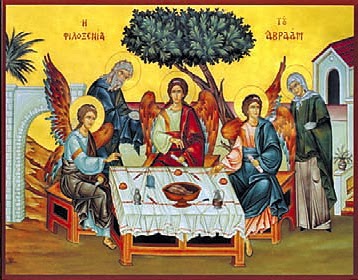
The Hospitality of Abraham
In her poem, "Making the House Ready for the Lord," Mary Oliver writes
In her poem, "Making the House Ready for the Lord," Mary Oliver writes
Dear Lord, I have swept and I have washed but
still nothing is as shining as it should be
for you. Under the sink, for example, is an
uproar of mice . . . (read the entire poem here).
How do you prepare for the presence of God in all of God's intimacy and intensity during the holidays?
You might think of holiday preparation as a matter of doing for others: cleaning, baking, decorating, purchasing and wrapping. You prepare for the presence of God by preparing for others.
But how do you show hospitality to God through caring for yourself when those other preparations have become burdensome, painful, or perhaps no longer doable at all?
Who, or what, are the mice, the squirrels, the limp raccoon, the dogs, the cats, the foxes, the sparrows, the shivering sea-geese who have taken up residence in your own life?
Do you need to shoo them out the door?
Do you need to welcome them in some way that has not yet made itself known to you?
Do you need to make everything shine for God?
Or is God perhaps going to work on polishing up something for you which once became tarnished and which you believe cannot shine anew?
still nothing is as shining as it should be
for you. Under the sink, for example, is an
uproar of mice . . . (read the entire poem here).
How do you prepare for the presence of God in all of God's intimacy and intensity during the holidays?
You might think of holiday preparation as a matter of doing for others: cleaning, baking, decorating, purchasing and wrapping. You prepare for the presence of God by preparing for others.
But how do you show hospitality to God through caring for yourself when those other preparations have become burdensome, painful, or perhaps no longer doable at all?
Who, or what, are the mice, the squirrels, the limp raccoon, the dogs, the cats, the foxes, the sparrows, the shivering sea-geese who have taken up residence in your own life?
Do you need to shoo them out the door?
Do you need to welcome them in some way that has not yet made itself known to you?
Do you need to make everything shine for God?
Or is God perhaps going to work on polishing up something for you which once became tarnished and which you believe cannot shine anew?
Subscribe to:
Posts (Atom)