Saturday, October 3, 2015

A Congregation Comes to An End -1


For nearly two years, my little congregation has been struggling to stay open, to merge with another congregation, to re-create itself, and now ~ finally ~ to close.

Much of what has happened has not been bloggable, but the time has come to go public, at least to some extent.

In a nutshell: a month after my arrival at the church, an unforeseen financial crisis resulted in a significant decrease in our income.  Eventually, we approached two other congregations about some sort of potential relationship.  One quickly backed out of our discussions.  With the other, we spent many months exploring a possible merger ~ and then it backed out as well.  At that point, we were financially strapped and our leadership was exhausted.  We made a few efforts to renew ourselves internally, but it became apparent that there was no energy for a new start, and on September 13 the congregation voted to close the church by the end of the year.

That little paragraph represents a mountain of hard work, frustration, hope, and sadness.

For the next several weeks, my sermons will be addressed to this particular context: a congregation on the verge of closing.  And I am going to write about the process, to the extent that I can.  Maybe someday, I'll write about the entire enterprise.
 
Tomorrow: World Communion Sunday, followed by a Congregational Conversation over a meal, as we begin to process reality together.


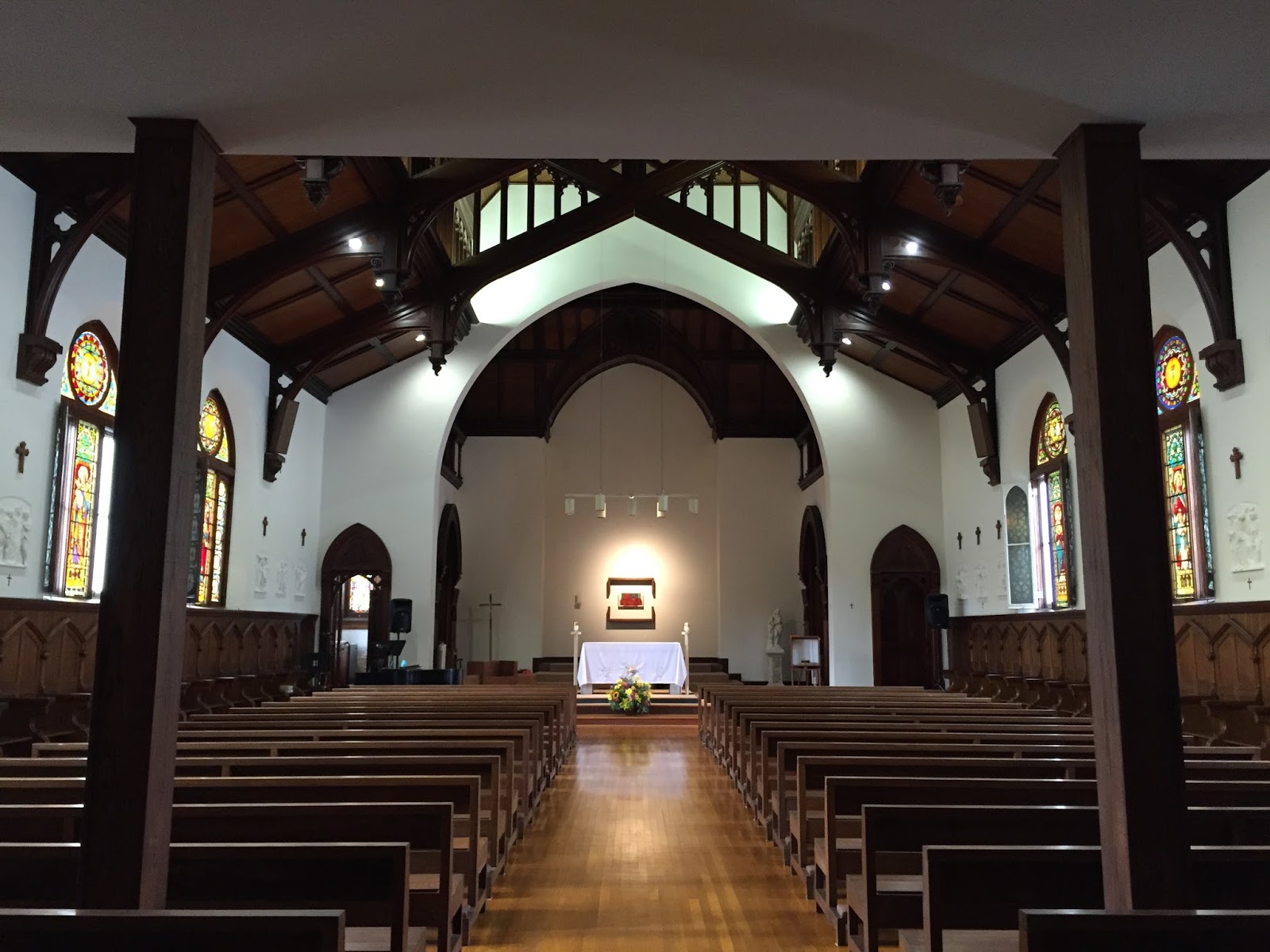
Image: Our sanctuary.  When I posted this picture on FB, a friend commented that it was beautiful, but would look better full of people.  Indeed.  That would be the problem.

Friday, October 2, 2015

My Mother, My Brother, Me


Fifty-five years is a long time not to have lived.

I've been pondering for days: what to write, about a mother and brother who barely had a chance? 

About growing up with half your family missing?

About what it might have been like to have had a mother with whom to share all of life's events, the big ones and the small ones?

I think that what I most regret this year is that: I don't know who they were.

My brother Dud never got to become who he was.  Today, had he lived, he would be almost 56.  What would he have loved as a boy?  Where would he have gone to school?  Would he have married and had a family?  What would have been his profession, his passions?  Would we be close friends, as my brother David and I are?

And my mother? I have a few things -- some pictures, one letter, and a fragment of another, some jewelry.  I have a few clear memories, and so I know that we, her children, were dear to her, and that she was kind and gracious and friendly.

What I have realized that I don't know at all is this: What did she care about, out there in the world?   What were her passions?  What might she have discovered and pursued, had she gone back to college when her children were grown?   Would she have become a determined advocate and fund-raiser for any causes?  A writer?  A world traveler?

And what about us, her children and grandchildren?  What would have been her priorities for us, in high school and college?  Have would she had responded to our mis-steps and failures?  Would we talk on the phone every day?  Would she have shown up and made pots of soup and changed sheets and vacuumed the house during those miserable pregnancies of mine?  Would she have been here for births and a death, for cancer and a broken ankle?  Would she have come to recitals and plays and games and graduations?

Would we have grown up in Florida?  That, I think, was the plan.  My parents had built a house for us in Vero Beach the Spring Before, and then we went back to Ohio.  When we returned to Florida the next year, would it have been for good? 

Who might I be, had I grown up in Florida instead of Ohio, at home instead of at boarding school,  with a mother instead of not?

But most of all, I just want to know:  What would she have to say? About anything at all?


Image: Vero Beach FL, May 1960 ~ a few months before they were killed in an automobile collision.


Saturday, September 26, 2015

Honor One Another - Sermon


As many of you know, I spent part of my vacation last week with my 83-year-old dad, canoeing in Canada.  My dad is a great storyteller, and last week he was full of stories about his years in business.  The family business was a grain business in a small town in southwest Ohio, a business founded by my great-grandfather in the early 20th century.    Do you know what a grain dealer is?  You’ve seen these business, with their silos and tall grain elevators, out in the country and in small towns.  Essentially, grain dealers are middlemen between farmers and big grain merchants, selling seed and fertilizer to farmers in the spring, and buying their crops in the fall to sell them to larger buyers.  When I was a child, there were four prosperous grain dealerships in my small hometown of a few thousand people.
One of my dad’s stories this past week involved his grandfather’s dealings with two customers one morning.  The first came in with his truck full of corn and said to my great-grandfather, “Well, Bert, I might as well let you cheat me as anyone else! What’ll you give me for my corn?”  So my great-grandfather made an offer, and the farmer countered, and the haggling began.  Eventually they reached a price.

Awhile later, a second customer arrived with a truck full of corn and approached my grandfather.  “Well, Bert,” he said, “I’ve got a load of corn for you, and I trust that you’ll do the best you can for me.”  They talked for a few minutes and, again, a price was agreed upon. 
After that customer left, my dad said, “Grandfather, it seems to me that you paid that first man a little less than his corn was worth, and the second a little more than his was worth.  Why is that?”

“You could be right,” said my great-grandfather. “I’ll tell you: That first fellow came in here filled with suspicion.  He insulted me right of the bat, and it was clear that we were going to bargain over the price, no holds barred.  So he set the tone, and my task was to bargain him down. And maybe I did get the price down a bit lower than I might have otherwise.
“But the second fellow, he came in here and said, ‘I trust you to do the best you can for me.’ He kind of put me on my honor, didn’t he?  And so I probably did pay him a little more than I should have, because I was bending over backwards to make sure I did the right thing.”
 
Just a couple of transactions, a couple of out hundreds that took place that fall.  But they say a lot about the different ways in which we approach one another, don’t they?
 
How do we as people of faith approach one another?  How do we respond to one another?  Which farmer are we?  Which version of my great-grandfather are we? 
 
This is one of the great subjects of the Christian faith: How do we treat one another?  How do we care for one another?  If you watched any of the pope’s speeches or listened to any of his homilies, you know that we’ve been hearing about this subject all week.  Perhaps it says something about us as a country and about Christianity as a faith, that our newscasters and commentators have been so surprised and made so much of his openness to others and his insistence that we all extend ourselves to others, whether the topic be immigration, or the death penalty, or poverty, or interfaith relationships.  Maybe we continue to struggle with this sort of openness, of extending ourselves to others, just as Jesus’ original disciples did.

In Bible study on Thursday, we addressed the same topic.  We’re reading a book by Marcus Borg, The Heart of Christianity, and this week we were invited to think about how we respond to reality and to others.  Borg says that we tend to respond in one of three ways: fearfully, indifferently, or openly.  The disciples and Jesus in our story today certainly exemplify two of those ways: the response of fear, and the response of openness.                        
The disciples have, in a very short time, come to think of themselves as the elite, as Jesus’ special followers.[1]  They want to think of themselves as an exclusive group, as the group  which understands Jesus’ teachings, which has found favor with Jesus, and which has the sole right to act on his behalf.[2]  And so they respond with fear, as adversaries, to others, who have been healing in Jesus’ name.  They sound like little kids: they shouldn’t be doing that!  They shouldn’t be healing people! We’re the ones who get to do that!

They draw lines: we’re in, you’re out.  We’re in separate groups, on opposite sides, with different interests. They are not unlike my great-grandfather’s first customer: I’ve got to stand up for myself, because I can’t trust you to do that.  The great theologian Walter Bruggemann refers to this as an attitude emerging from a conviction that we live in a universe of scarcity.  There isn’t enough to go around.  If people are going to be healed through the power of Jesus, we are the only ones who can do that.  If there’s a harvest to be sold, I need to make sure that I get my share if the proceeds, because no one else is looking out for me.   This is a scary world filled with limitations; it’s a threatening kind of place, and I need to be sure to defend what’s mine
Jesus has some harsh words for those whose actions are motivated by fear – some of his harshest words in the Bible: If you place a stumbling block before people, if your hand or your foot or your eye causes you to stumble – better that disaster befall you, or your body parts, than that you in some way block others from the deepening of life that I have to offer.  Jesus in this passage is actually a lot harsher than Pope Francis has been this past week.  Pope Francis has been emphasizing a “culture of care,” but Jesus goes right to the consequences of a culture of fear, of suspicion, of self-protection and self-defense -- and they are not positive consequences!    Better that you get out of the way than that you limit the prospects of others for new life – whether those others be prisoners on death row, immigrants to a new country, the poor and disenfranchised, or those whose beliefs differ from yours.

If we are not going to be people trapped by a vision of scarcity, limited by our fears and barricade against what we see as threats in this world, than who are we going to be?  How are we going to be FOR Jesus – who says to his disciples, those followers so confused about their role and so convinced that they should come out on top – Jesus who says, “Those who are not against us are for us.”  Look for possibility; look for hope. Align yourself with a conviction that we are a people of abundance, not scarcity – that there is enough love, enough healing, enough care, enough life – for all.  In  fact, there is more than enough – there is an abundance! 
Wasn’t that the approach of my great-grandfather’s second customer?  “Do the best you can for me.” He came to work that day in a spirit of openness and trust, prepared to think the best of his customer, prepared to see grain business and famer as allies.  And didn’t that in turn bring out the best in my great-grandfather toward his customer?  Both men saw this as an opportunity for life – for profit, of course, because it was a business transaction, but also for kindness and fairness and dignity,

Isn’t that what the Pope has been talking about all week?  The Catholic St. Ignatius, founder and father of the Pope’s Jesuit order, tells us always to presume the best in the other. Marcus Borg, author of our study, tells us always to anticipate and pursue what is life-giving. 
And Jesus tells us today: Have salt.  Be at peace with one another.  Preserve the best in and for one another. Season and flavor your relationships with life, with hope, with caring – with possibility at its very best.  Do the best you can for one another. Amen.               


[1] Micah D. Keil’s Commentary in Working Preacher for September 27, 2015.  http://www.workingpreacher.org/preaching.aspx?commentary_id=2619
[2] Amy Oden’s Commentary in Working Preacher for September 30, 2012. http://www.workingpreacher.org/preaching.aspx?commentary_id=1357

Friday, September 25, 2015

Friday Five: Push or Pull

Today's Friday Five comes from Deb:
 
"I am fortunate to have some great encouragers in my life. The ones who know me the best are great at knowing when to challenge me, and when to just chill and let me figure it out myself. SO… think about the encouragers and challenges in YOUR life and tell us…"
 
1. After achieving a goal, do you set the bar higher, or rest on your laurels?
 
I usually set the bar higher.  But I've got nothing against taking a break.
 
2, Which is better: a kick in the pants or a hug and a cuppa?
 
Oh, definitely the hug.  I am not particularly responsive to criticism.  I mean, I make mid-course corrections all the time in response to feedback, but you can make it a lot easier on both of it if you have something positive to say.
 
3. What’s your baseline motivation? Fear? Competition? Not getting caught? ;)
 
I am pretty damn competitive.  But that driving force has little place in my life these days.
 
4. When you’re facing a big challenge, do you need to talk it out, or puzzle it out yourself?
 
I need to talk it out, at length and with anyone who might have something to contribute.
 
5. Who is in your corner – always? Who helps you achieve more than you imagined you could?  (You don’t have to give names)
 
I have a couple of mentors and colleagues who are always hugely supportive.  And my kids ~ they're amazing.  My daughter at 28 is insightful, compassionate, and articulate ~ often my go-to person whether I'm moving forward or completely stuck.
 
I don't have a bonus piece of art of music.  Just the number . . .
 
3!


Tuesday, September 22, 2015

Spiritual Direction: Preparation

At the Jesuit University at which I teach as an adjunct, the students are offered an opportunity at the end of winter break to make a weeklong silent retreat at the nearby Jesuit Retreat House. A week of 24/7 silence, broken only by the daily liturgies and daily reflective, one-on-one meetings with spiritual directors. During the fall semester, the students are expected to attend a few meetings and complete some reading in preparation for the undertaking ahead of them.  That sort of a week is a challenge for the most experienced of adults.  For an 18-year-old?!
 
Some years ago, I was speaking with a young woman about her retreat experience, and asked her how she had done with the required preparation.
 
"I didn't get to any of it," she laughed.
 
"And how did your retreat director respond?" I wondered.
 
"Father G was my director," she responded. 
 
Ah.  Mine, too, once a week, as I was making the Ignatian Spiritual Exercises that year.  I didn't mention that to her, but I did ask if she'd told him the truth.
 
"Yep," she said, "and he told me not to worry about it.  He said that my whole life up to that point has been a preparation for the retreat."
 
I've had formal training and lots of continuing education as a spiritual director.  But I learned the most about it from HG, my own first director, and a lot of what I learned can be found in that one sentence. Our whole lives are the subject of our prayer, however it is that we find ourselves praying.  Our whole lives are fodder for growth in our relationship with God, no matter how casually or ineptly we approach it.
 
Now . . . if I could just remember that for myself.

Monday, September 21, 2015

Life with Nuns


My friends are sometimes startled to learn that I spent three years in a Catholic school.  A Catholic girls' school.  A Catholic girls' boarding school.
 
I was only twelve when I was deposited with the nuns, in a pre-Vatican II environment of fully habited nuns, Latin masses, saints' days, required daily religion classes, and words like refectory and collation.


It's a long story, one which I won't relate here.  But it might reflect a thread of grace, one that began to unwind in the 1890s when my very Methodist great-grandmother drove her buggy ten miles through the country to the convent for piano lessons, and was most recently in evidence when I went to our reunion last Saturday.
 
As I visited with the hundred or some women there for lunch, reports, hugs, and laughter, I mused on the experiences we had shared, so different from those of most of our contemporaries.  
 
The navy blue skirts, white blouses, and saddle shoes.  The little alcoves, beds and side tables lining the length of long, third-floor dormitories and separated from one another by white curtains.  The midnight conversations as we curled up in our nightgowns in wide window wells overlooking well-maintained grounds. 
 
The many efforts we made to break into the off-limits cloistered hallways secreted behind closed, unmarked doors. The evening study groups, radios blaring and books strewn across desks as we tried to unravel the mysteries of algebra and dreamed of encounters with Paul McCartney. The Saturday afternoon sewing classes, from which some of us routinely escaped to undisclosed locations. 
 
The alternating mystery and boredom of the Latin mass.  The glowing woodwork and high windows and ceilings we took for granted.  The very, very distinct personalities of the nuns, brilliant and highly educated women who presumed that we would, too, would grow into forces to be reckoned with. 
 
Thanks to modern technology, we are all re-connected,  30 and 40 and 50 years after we shared convent school life.  A couple of the nuns attended my ordination four years ago.  They really love us.  We really love them. 
 
Real, true, amazing, grace.


Sunday, September 20, 2015

Fragments of Grace: New Blog Name

 
So many permutations over the years.
 
Midlife Matters ~ yes, a play on words ~ begun over eleven years ago, in the hope of exploring the adventures of a midlife wife, mother, lawyer-turned-teacher, spiritual explorer, traveler, and photographer.  An AOL journal enmeshed in a hesitant but hopeful community of writers suddenly offered a public platform.
 
Search the Sea ~ the blog that emerged from the AOL crash. By that time, the spiritual search had become paramount in my life, and at first I imagined myself as a gannet (my screen name back in those days of online anonymity was Gannet Girl), a seabird soaring across the waters of the ocean, always seeking and never landing for good.
 
Desert Year ~ the place in which I began to deposit the writing pertaining to my son Josh's death by suicide, writing too dark to be supported by any gannet sailing through the sky.
 
Metanoia ~ the name upon which I settled when I concluded that, like it or not I was in the throes of  Deep Change, and might as well try to embrace reality.
 
Beautiful and Terrible ~ that's been the name of this blog for quite a while.  It comes from a Frederick Buechner quote, and represented a form of hope: that I would somehow manage to see both, even when the terrible seemed to overtake all else.  Buechner is a Presbyterian pastor who lost his father to suicide, so we share a couple of experiences in common, albeit no doubt also differently.
 
Fragments of Grace is my take on the title of Mary Doria Russell's novel A Thread of Grace (about the Italian resistance during World War II, not about Jesuits in space), one of my very favorite books.  Her title comes from an old Jewish quote: No matter how dark the tapestry God weaves for us, there's always a thread of grace.
 
I am willing to admit that it takes a better, or at least a different sort, of person than I to see a thread of grace.  I belong to a faith tradition in which people are comfortable talking about "God's plan."  I hear it all the time from elderly Presbyterians in hospital rooms and from young Catholic college students responding to life crises.  I am a good deal less sanguine than most of them are about the details of this plan.
 
But I am willing to acknowledge fragments of grace.  I am even willing to celebrate fragments of grace. 
 
For seven years now, I have lived the experience of walking across a sea of fragments of glass, of metal, of ice.  Sharp, jagged, shifting fragments.  These days, it seems that they glisten with light from above more than they reflect the darkness of the depths below.  
 
Who knows?  Perhaps they are connected by a glowing filament invisible to me.

For now, though: Fragments of Grace.